Rajputi Poshak Photoshoot: 14 Poses, and the Light That Makes Them Work
Photograph a Rajputi poshak in low, sideways light — the first hour after sunrise or the last hour before sunset — keep the camera at her chest height instead of your own eye level, and leave her enough floor to turn so the kalis of the ghaghra open. Those three habits will do more for your pictures than any pose list, this one included.
We watch the same photograph go wrong most weeks at the shop. A girl comes in for her final fitting, she sees herself in the long mirror and something shifts in her face, somebody lifts a phone, and what comes back is flat. The red has gone orange. The gota, which a karigar sat over on the adda for days, is a grey smudge. Her odhna has slipped off the far shoulder and nobody said anything.
None of that is her fault and none of it is the poshak's. A poshak is four garments — kanchli, kurti, ghaghra, odhna — each catching light its own way, and it has to be photographed as cloth in motion rather than as a dress standing still. What follows is what we have learned watching our own pieces get photographed in courtyards, on terraces, and in the half-dark of the workroom at seven in the morning: fourteen poses that work, the timing, the pinning, and the parts nobody tells you.
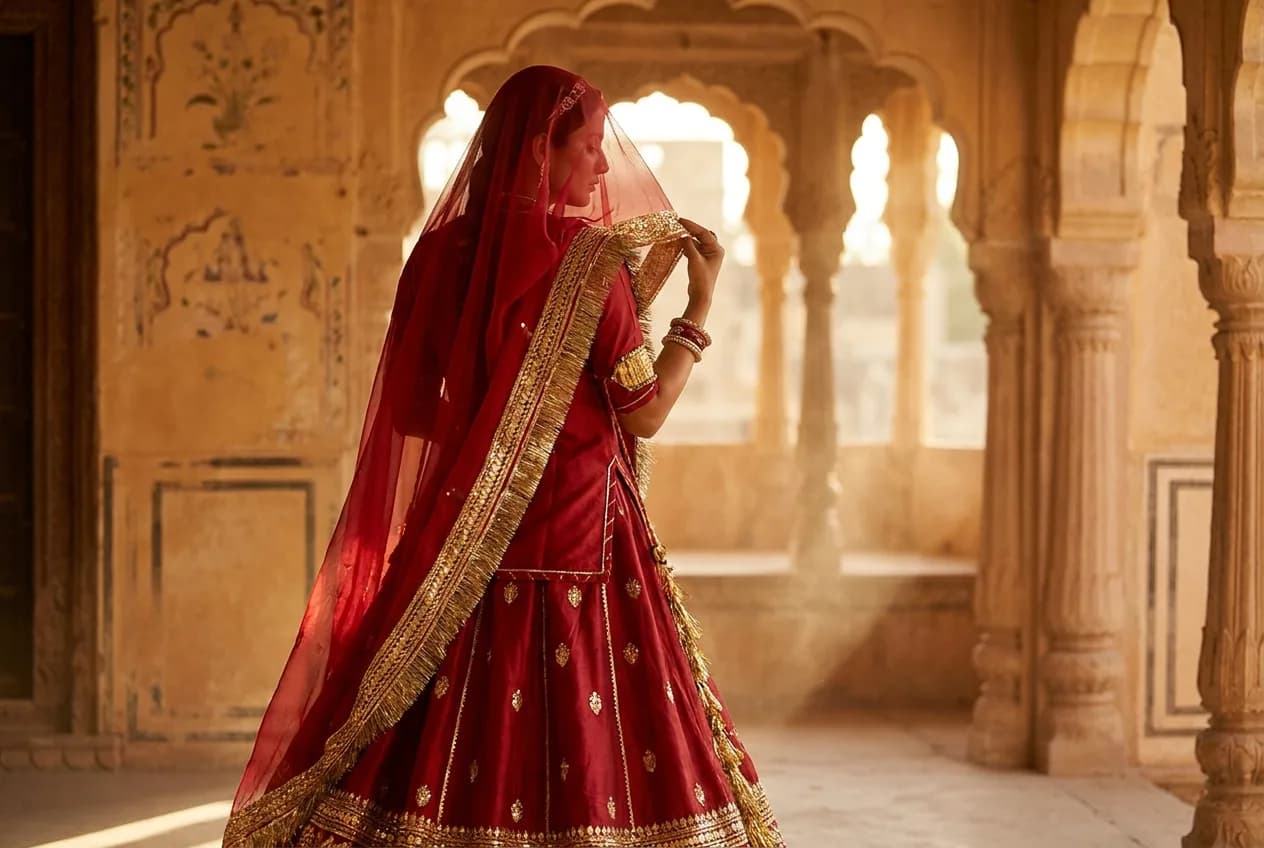
A poshak is not photographed like a lehenga
Four garments, four jobs. The kanchli sits close and holds the shape. The kurti floats over it and softens the waist. The ghaghra carries the weight and all the movement. The odhna decides the photograph — where the eye lands, how the face is framed, whether the picture reads as a bride or as fancy dress.
Most shoots go wrong at one decision. The photographer stands at their own eye level and shoots straight on. From up there a 24-kali ghaghra collapses into a triangle, the kor of the odhna hides behind the shoulder, and the tari work along the hem falls into shadow. Drop the camera to her chest height, or lower, and the same poshak grows.
The next thing is light with a direction to it. Gota, danka, mukesh and real-silver kiran are all reflectors. They only exist on camera when light strikes them at an angle and comes back at you. Noon sun, straight down, gives them nothing to return. A low sun, or a window on her left, and every thread picks up an edge.
Then movement. Ask her to walk, to turn, to tie something, to pull the odhna forward. A heavy bari poshak photographs best in the half second after it stops moving, not in the pose she has been holding for eight seconds while somebody keeps saying one more.
One more thing we notice on the finishing table and nobody notices on a shoot. A piece has to be checked flat and then again on a body, because gota that runs dead level on the table can sit a finger higher on one shoulder once the odhna is pinned. Look at her shoulders in the first frame before you take fifty.
Fourteen poses that actually work in a poshak
- 01The Odhni Fall
Three-quarters to the camera, weight on the back foot, front foot pointed lightly toward the lens. She pinches the odhna's edge between thumb and forefinger at hip height, arm loose, and lets the rest fall from the crown of the head down the far shoulder. What ruins it is clutching the odhna at the chest, which shuts the whole line of the body. Have her lift the edge two inches and let it go on a count of three, then shoot just after it settles. The held version always looks held.
- 02The Kali Turn
Turn her away, then bring her back through roughly ninety degrees. On a 24-kali ghaghra the panels open in the second half of that turn and close again fast, so shoot in burst and keep the camera low. Feet pivot. They do not shuffle. Honest tip: three turns is the limit. After that the odhna comes off the shoulder, the pins lose their grip and she is dizzy while carrying a great deal of velvet.
- 03The Ghunghat
The hidden-face frame, and the one we are asked about most. Draw the odhna forward from the parting until it sits just past the browline, chin dropped a little, both hands on the kor at collarbone height. Shoot from slightly above her eye level so light still reaches the jaw. Leave a thumb's width of face showing. A full blackout reads as a stock photo. A glimpse of the nath, the mouth, one earring reads as a bride.
- 04The Kor Shot
The best handwork on most poshaks runs along the odhna border, so give the border a frame of its own. Back to the camera, feet together, arms relaxed, odhna opened wide across both shoulders so the kor runs unbroken from wrist to wrist. Take a second one with her looking down over a shoulder. Do it against a plain wall and nothing else — carving or pattern behind will fight the gota, and both lose.
- 05The Haveli Step
Seated on the second or third step, never the bottom one. Ghaghra pooled forward over the step below so the kalis spread down like water, one knee higher than the other, one hand on the raised knee, the other taking weight behind her. Camera at her eye level or under it. Honest tip: slip a spare cloth under her before she sits. Old stone chews through real-silver kiran faster than anyone expects, and a snagged kiran wire cannot be pushed back in on the day.
- 06The Fanned Kali
On the floor, legs folded to one side, and someone off-camera opens the ghaghra outward into a half circle around her. The photographer stands directly over her, phone parallel to the ground, and shoots straight down. Shoot this one early. Two hours of sitting puts creases in the kalis that only show from above, and by then it is the one frame you cannot retake.
- 07The Jharokha Lean
Forearms on the stone sill, torso angled into the window, face turned out toward the light. Keep the odhna over one shoulder only so the back ties of the kanchli show. Expose for her face and let the world outside the window go bright and white. Saving the view outside almost always costs you her skin, and nobody is looking at the view.
- 08Borla and Bangle
A close crop. No face needed, and it is the easiest good photograph of the whole day. Hands lifted to settle the borla at the parting, chooda and kada stacked up the forearm, lens brought right down to hand height. Shoot it in open shade. Direct sun turns polished silver into a white smear and the chasing on the borla disappears with it.
- 09The Walk-Away
She walks away, slowly, and looks back once at about the fifth step. The photographer stays low and lets her get further than feels comfortable. Tell her to take shorter steps than come naturally — short steps swing the ghaghra in a proper arc and let the odhna trail behind her instead of flapping out sideways.
- 10Banna-Banni
The couple frame. He stands half a step behind her shoulder, both bodies facing the same way, her odhna crossing loosely in front of him so the two are joined by cloth rather than by a grip. His hand at her upper back, not her waist. Dress him to the odhna's border colour rather than to the ghaghra. It keeps the poshak the loudest thing in the picture, which is the point of the picture.
- 11The Aarsi and the Selfie
For a phone selfie: hold it a touch above eye level and off to one side, elbow lifted so the bajuband and bangles come in, odhna pulled forward on the near side to shape the jaw. For the mirror version, stand at a slight angle to the glass so the back kor and her face both land in the same photograph. Wipe the mirror. Then switch off the ceiling light — window light on its own is far kinder than a tube light and a phone flash arguing with each other.
- 12The Bari Portrait
Bari day. Straight to camera, seated, chin level, shoulders squared, hands loose in the lap with one resting over the other. Rakhdi centred on the parting, aad flat along the collarbone, nath resting rather than pulled. Shoot from about six feet at chest height with the longest lens you have. Honest tip: check the aad in the frame, not on her. It drifts left every single time she moves and you will only catch it at home. Our [jewellery guide](/journal/rajputi-jewellery-guide) sets out what sits where.
- 13The Teej Circle
Friends. Please do not line them up shoulder to shoulder like a school photo. Two seated on a step, two standing behind at different heights, and everybody given something to do — tying a gajra, straightening someone's odhna, laughing at whoever is slow. Break the colours up. Four reds in a row cancel each other out, and a rama, a firozi or a piliya between them lifts the whole group.
- 14The Hands-Busy Frame
Keep this one for the woman who goes stiff the moment a lens appears, which is most of us. Give her a task. Lighting a diya, folding the kor, carrying a thali, drawing the ghunghat forward. Shoot continuously through the action instead of waiting for the end of it. This is the frame that ends up as the DP more often than the posed portrait, because the face is busy doing something real and it shows.
How we prepare a poshak before a camera sees it
Steam it, never iron it. Velvet is steamed from the wrong side and hung overnight on a padded hanger with the ghaghra's waist loosely tied — never folded into a bag and never pressed. An iron laid flat on velvet crushes the pile into a shiny patch, and no amount of editing takes that patch out. Silk and satin want the steam held a hand's width away, not touching.
Bring the silver back. Asli chandi gota goes dull if a piece has sat in a box through a humid month. A soft dry cloth worked along the thread, in the direction the gota runs and not across it, is enough. No jeweller's dip, no toothpaste, no rubbing at it with a paste. The wire is fine and the backing thread will come away with the tarnish.
Leave the butter paper in. Every piece goes out of our workshop with butter paper folded into the odhna's fold so the silver is not lying against itself in the trousseau box. Keep it there until the morning. It is doing more work than it looks like it is.
Do a walking trial. Get her into the full poshak the evening before for ten minutes. Ten steps, sit down, stand up, one turn. That is when you find that the hem is a finger too long for the steps you chose, that a shoulder pin needs to go through the kanchli seam rather than the kurti, that the chooda catches on the odhna's kiran every time she lifts her hand. Fixing any of it takes five minutes the night before and derails an hour on the day.
Pack the small box. Six spare pins, a needle already threaded in the colour of the odhna, the spare dori for the kanchli, a soft cloth for the silver, safety pins for the ghaghra nada, and a bottle of water with a straw so her lipstick survives. Our karigars keep exactly this on the finishing table, and it exists because every item on that list has once been the reason a piece went back for repair.
One frame for the number. Each poshak we make is numbered and signed. Brides usually want a photograph of that, and it needs a window, a steady hand and a moment before the crowd arrives — not a phone flash at eleven at night when the piece is already creased.
Light, hours and what each fabric does
Hand this section to whoever is holding the camera. It is the difference between a good poshak looking expensive and a good poshak looking like a rental.
| Best morning hours | Roughly 6.45 to 8.30 AM in Jaipur through most of the year. Low sun rakes sideways across gota-kiran and puts a bright edge on every thread. |
| Best evening hours | The forty-five minutes before sunset and about ten after it. Reds go deep and stay true instead of drifting toward orange. |
| Hours to avoid | 11 AM to 3 PM. Overhead sun flattens gota to grey, drops shadow into the eye sockets and burns the odhna to white. |
| Overcast day | Very good for velvet and heavy lal. Poor for real silver, which needs one clear direction to shine from and gives you nothing under flat cloud. |
| Shooting indoors | Stand her about one and a half arm-lengths from a window, body at forty-five degrees to it, face turned toward the glass. That is a full studio setup and it costs nothing. |
| Velvet | Drinks light. Expose about half a stop brighter than the meter suggests or it turns muddy brown. Holds creases badly, so steam it and hang it and never fold it in the car. |
| Satin and silk | Throws hard bright highlights. Keep it out of direct midday sun, where it goes chalky. Shoots beautifully in shade and in the last light. |
| Georgette and jaali odhna | Needs light coming through it. Put the sun behind her and the weave reads; light it from the front and it vanishes. |
| Real-silver gota | Photographs cooler and softer than people expect, a grey-white sheen rather than a yellow flash. Plated zari reads warmer and glassier. Do not push silver toward gold in the edit — that is the one thing that gives a piece away. |
| Background wall | Old lime plaster in ivory, cream or pale grey beats anything decorative. If the wall has a pattern, the poshak has to fight it. |
| Phone versus camera | A phone at 2x in good light beats a camera at noon, every time. The camera earns its place on the full-length bari frame and in a dark courtyard. |
| Portrait mode | Careful. The blur algorithm cuts into jaali, stray gota edges and the odhna's fringe and leaves chewed outlines. Fine for jewellery crops, risky for full length. |
| Flash | One flash bounced off a white wall or ceiling is fine and often lovely. Direct on-camera flash flattens aari work on the kanchli and turns silver to glare. |
| Turns and movement | Burst mode, always. A kali stays properly open for about a third of a second and you will not catch it by timing. |
What your poshak will do on camera
| What she is wearing | How it behaves | Shoot it like this |
|---|---|---|
| Heavy lal velvet bari | Absorbs light, goes muddy in shade, glorious in low sun | Late evening, plain ivory or lime-plaster wall behind, expose slightly bright |
| Satin ghaghra with tari work | Bright specular highlights that blow out easily | Open shade or window light, camera low so the tari catches at an angle |
| Danke ka kaam | Small metal that needs a point source to spark | One direction of light, never flat cloud; move a step at a time until it lights up |
| Real-silver gota-kiran | Cool grey-white shine, quieter than plated work | Side light, open shade for close crops, no warmth added in the edit |
| Lehriya or bandhej odhna | Pattern fights a busy background and wins ugly | Plain wall, full-length frame, let the pattern be the only pattern |
| Baby pink and lighter shades | Washes out fast in bright sun | Cloudy day or evening; a darker wall behind holds the colour |
| 24-kali ghaghra | Only shows its fullness in motion | Turns, walking shots and the fanned floor frame, never standing still |
Hair, makeup, pins and mojari
Hair. The Rajputi look starts at the parting, and a heavy borla decides it for you. That chain has to sit along a straight centre seam or it slides within ten minutes and starts pulling hair, and then she is fixing it in half your photographs. Centre parting, front sections smoothed flat with a little water or serum, no teasing at the crown. After that, either a low juda at the nape wrapped with a mogra or bela gajra, or one thick plait brought over the front shoulder with the odhna pinned just above it. The juda gives you a cleaner back-of-the-odhna shot. The plait photographs better in profile and on the jharokha lean.
Makeup. Matte where the light hits. Skip a heavy SPF primer if there is any flash involved, because it throws white back at the lens and greys her out in exactly the frames you would have kept. Powder the T-zone, the collarbone and the tops of the shoulders, since bare skin next to a kanchli picks up shine badly. Kajal set properly in the waterline, lashes done, and a lip in the same family as the poshak rather than at war with it: a berry or a deep rose against lal, softer tones against pink. Take one test photograph with flash before the crowd arrives.
Pinning the odhna. This is where a shoot quietly falls apart. Two pins at the shoulder driven into the kanchli's seam and not into the kurti alone, or the weight drags the whole thing down inside an hour. One fine pin at the crown into the juda to hold the ghunghat line. One hidden under the magji at the waist so the odhna cannot slide off her back. Then appoint one person whose only job is to look her over every ten minutes. That person is worth more than a second camera, and I would say that in front of the photographer.
Feet. Mojari should show. Have the hem tacked so it clears the floor by a finger's width for the walking shots, and build two frames around the shoes — the seated step pose, and a low crop of feet on stone. Embroidered mojari against a red ghaghra hem is a photograph on its own, and almost nobody remembers to take it.
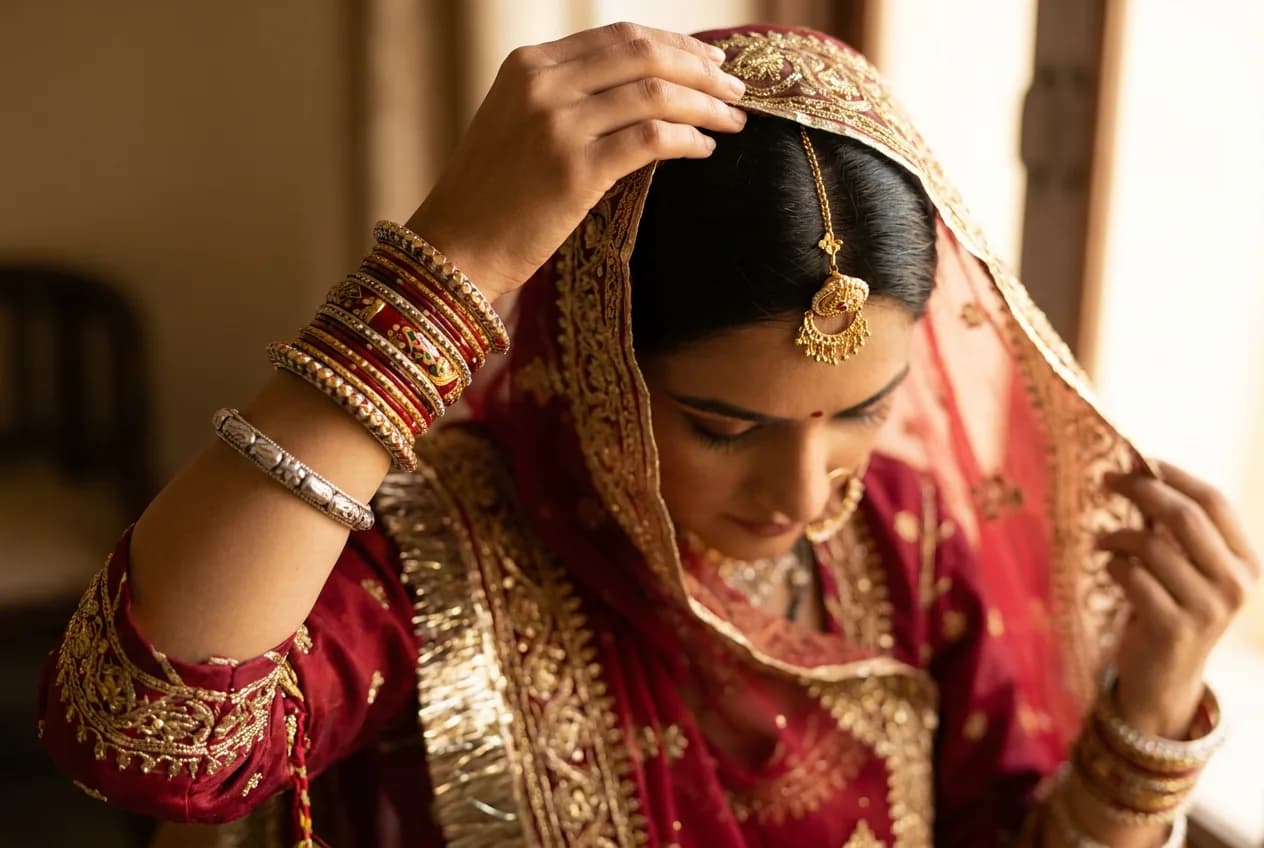
Jaipur and Jodhpur, honestly assessed
Plain walls first. If she is in a heavy red or a deep rani pink, the best background in Rajasthan is an old lime-plaster wall in ivory or pale cream. Nothing else in the frame. Heavy work needs empty space around it, and half the disappointing poshak photographs we are shown are disappointing because there was a carved pillar, a parked scooter and three plastic chairs behind her.
Haveli courtyards. A square courtyard with high walls gives you bounced light for about two hours after sunrise. Soft, directional, no hard shadow. Stand her against the shaded wall and let the sunlit wall opposite work as your reflector. Many older family havelis in Jaipur open for private shoots on request, and plenty of guesthouses in the old city will give you a courtyard for an hour if you ask properly and pay for it.
Jharokha windows. Look for one where the sill sits roughly at her waist. Higher and she has to reach, lower and she stoops. Sandstone photographs warm, which suits firozi, rama and the lighter shades more than it suits a deep red.
Stepwell-style baoris. The geometry does the work and you barely need a pose, only her seated three or four steps down with the ghaghra spread. Check before you go. Several of the well-known baoris and forts around Jaipur charge a separate photography fee, some want written permission for tripods and lights, and the rules change with the season. Ring ahead instead of arriving with a crew and being turned back at the gate.
Terraces at seven in the morning. Underrated, free, and the light is exactly right. A terrace with the city behind her and the sun low gives you the walk-away and the odhni fall with nobody's permission needed.
Jodhpur. The indigo lanes of the old city behind the fort are the strongest colour background we know for a red poshak. That blue against lal is a pairing nobody could design better. Go before nine, while the lanes are quiet and the walls are still in even shade. Rooftops facing the fort at dusk are the other one, where sandstone and last light flatter almost every shade we make. Our Jodhpur store on Link Road is ten minutes from most of those lanes, and the team there knows which walls have been repainted since last season — the address and hours are on our Jodhpur page.
Jaipur, if you are coming to us. Brides often finish a fitting at Jhotwara or Sanganer and want the first frames on the same day, which we like, because the piece is freshly steamed and pinned by hands that know it. There is more on both shops, and where the light is good near each, on the Jaipur page.
One request. If you are photographing in a residential lane, ask the family whose door you are standing in front of. People in the old city are generous about it, and it takes one sentence.
Poshaks built to photograph well
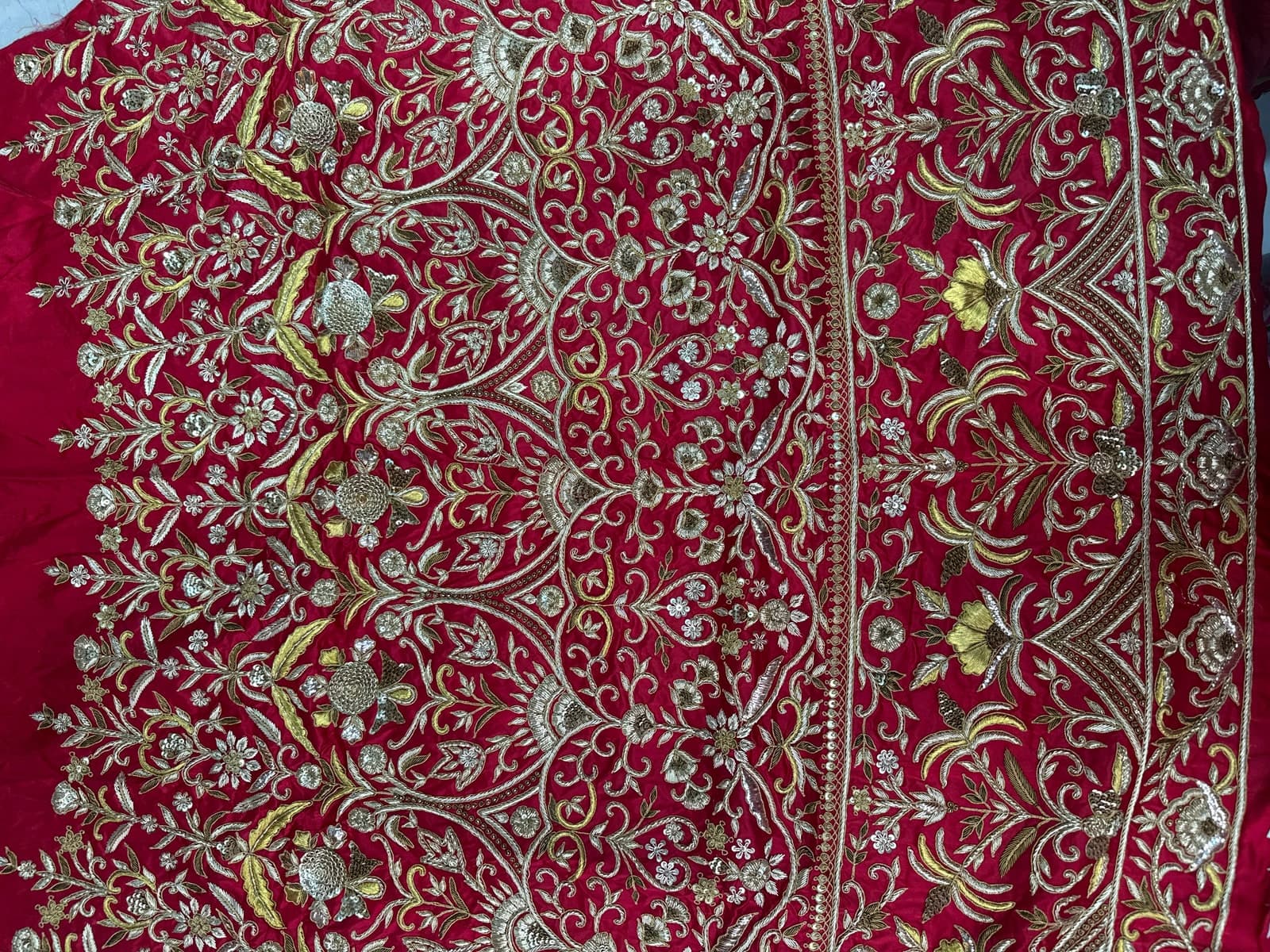
Crimson Bari Rajputi Poshak — Antique Golden Zari
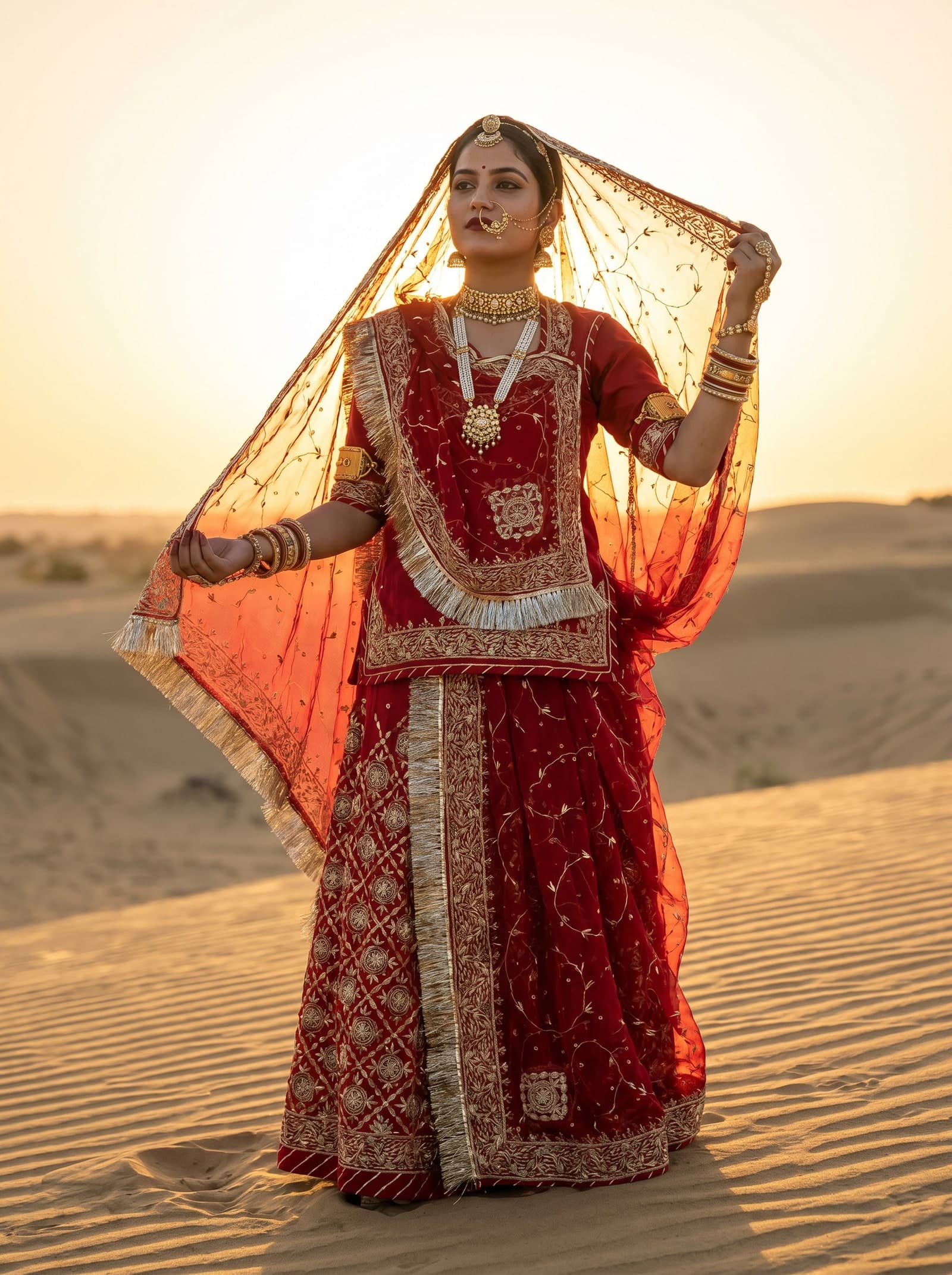
Deep Red Velvet Bari Rajputi Poshak
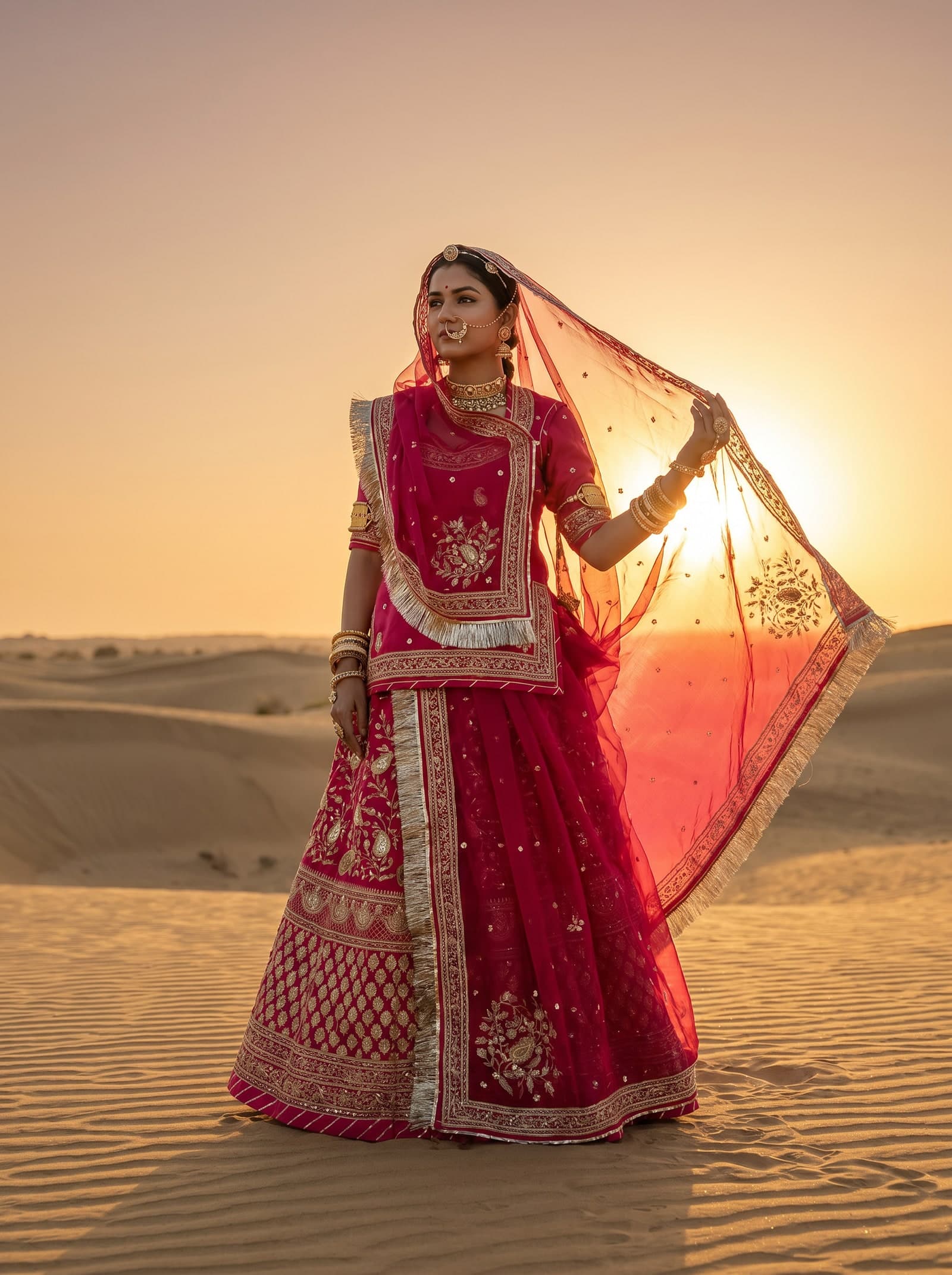
Rani Pink Bari Rajputi Poshak — Aari Zardozi
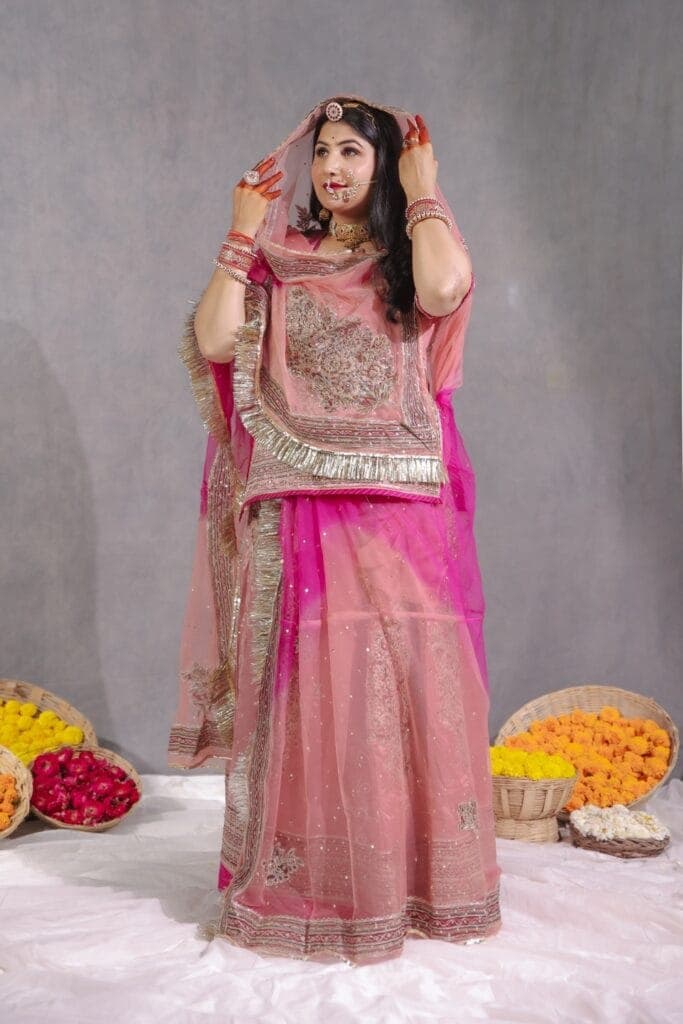
Designer Baby Pink Rajputi Poshak
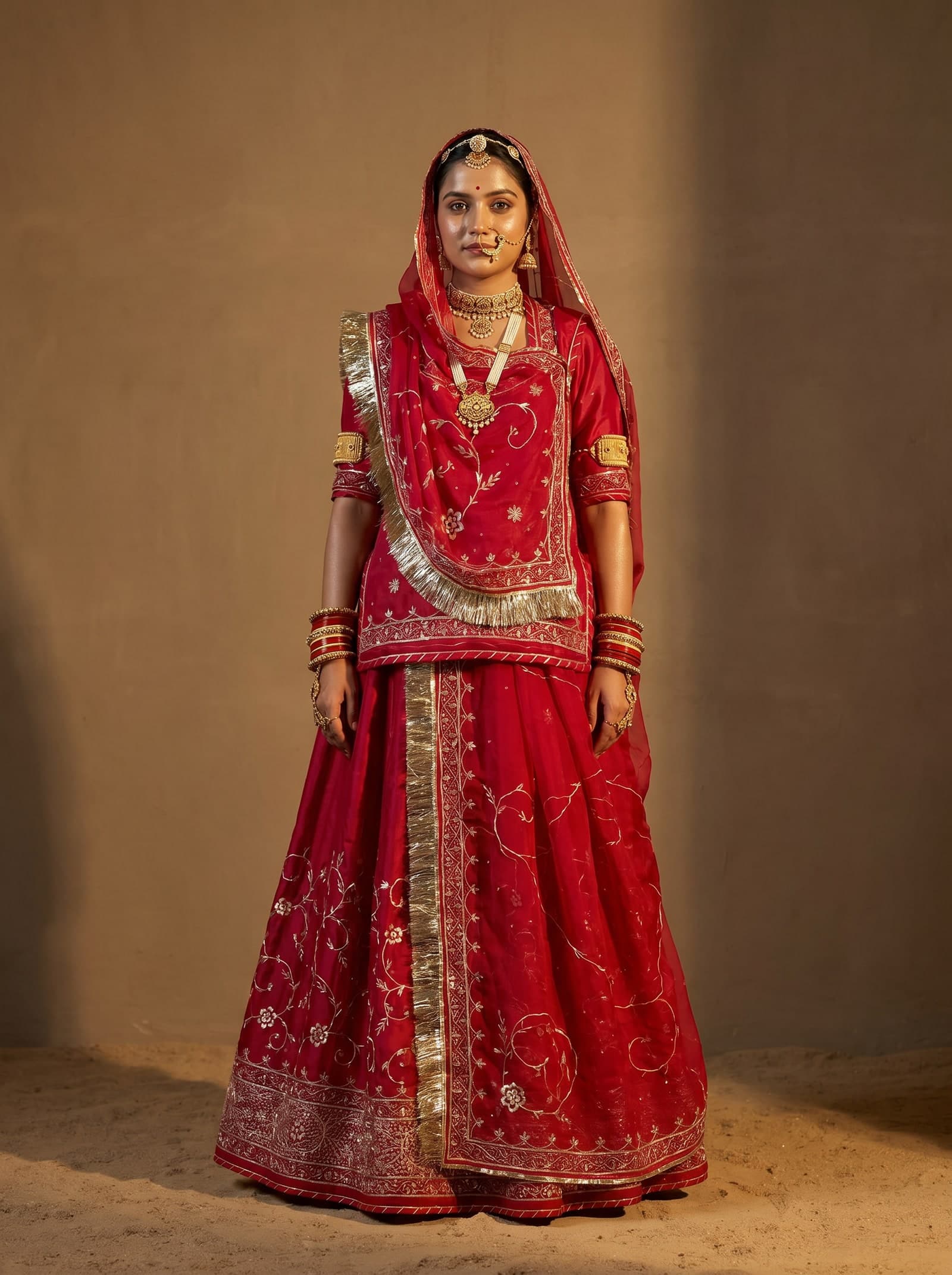
Red Bari Rajputi Poshak — Dabka
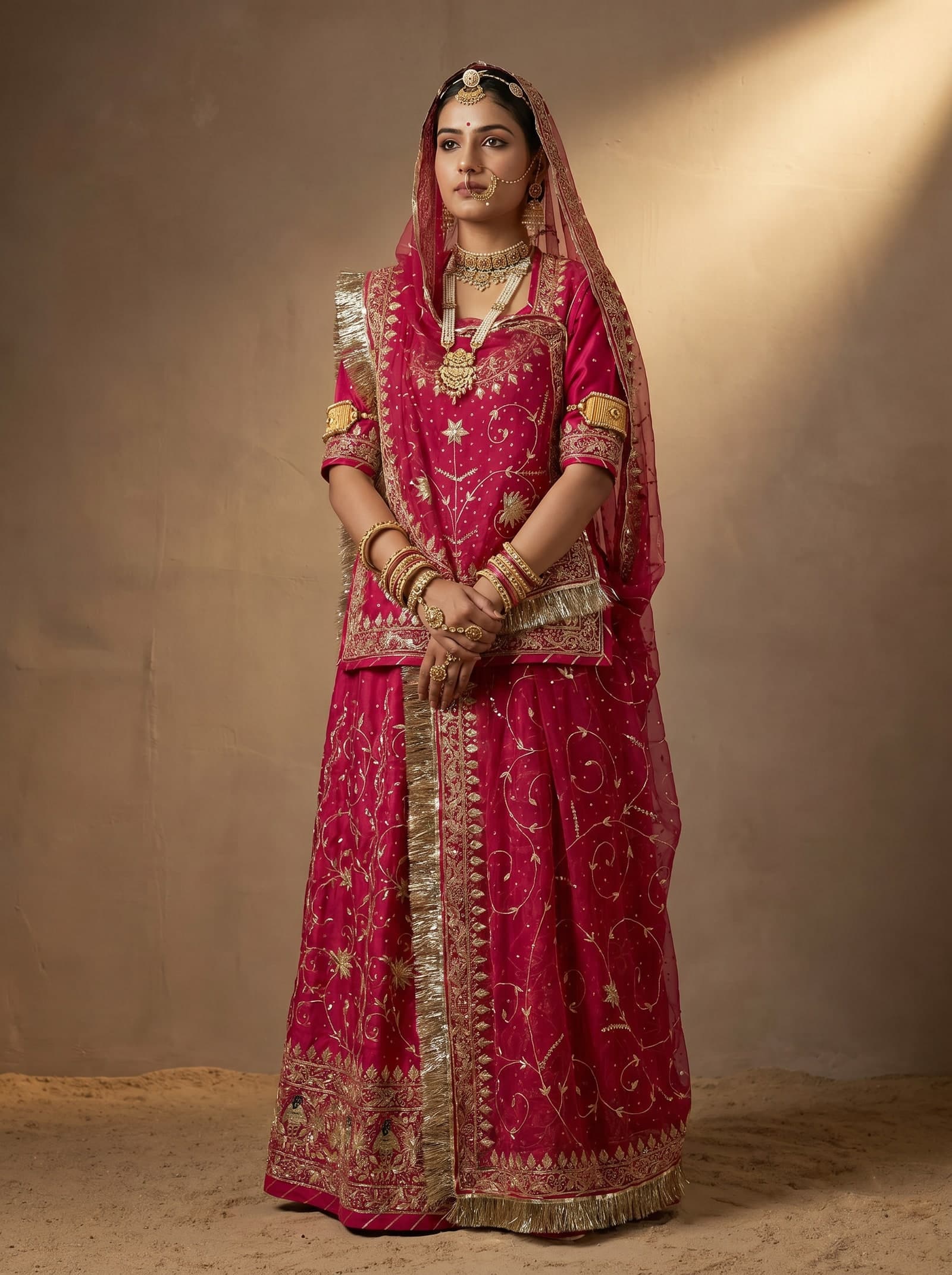
Rani Pink Bari Rajputi Poshak
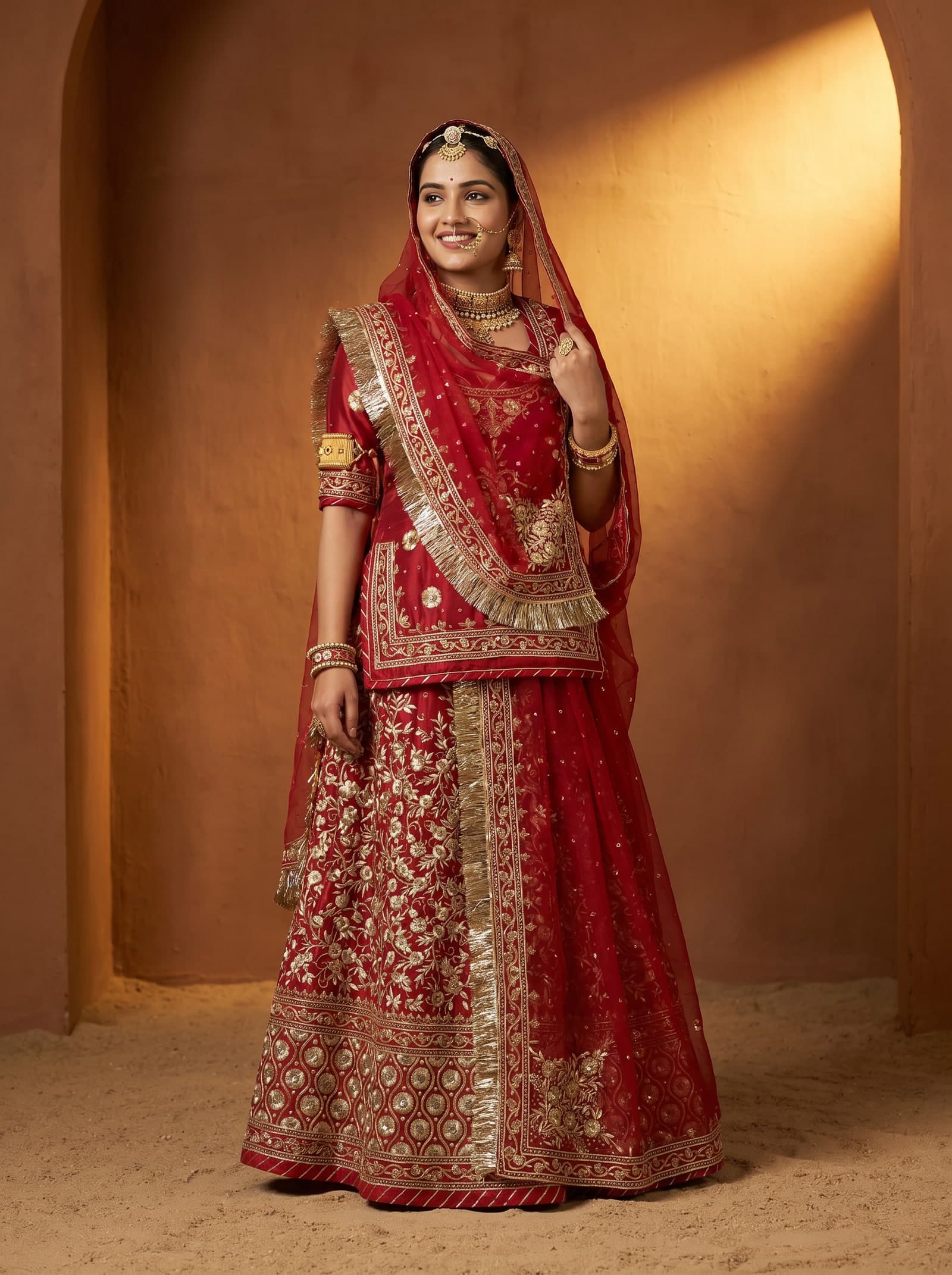
Red Bari Rajputi Poshak — Zari Jaal
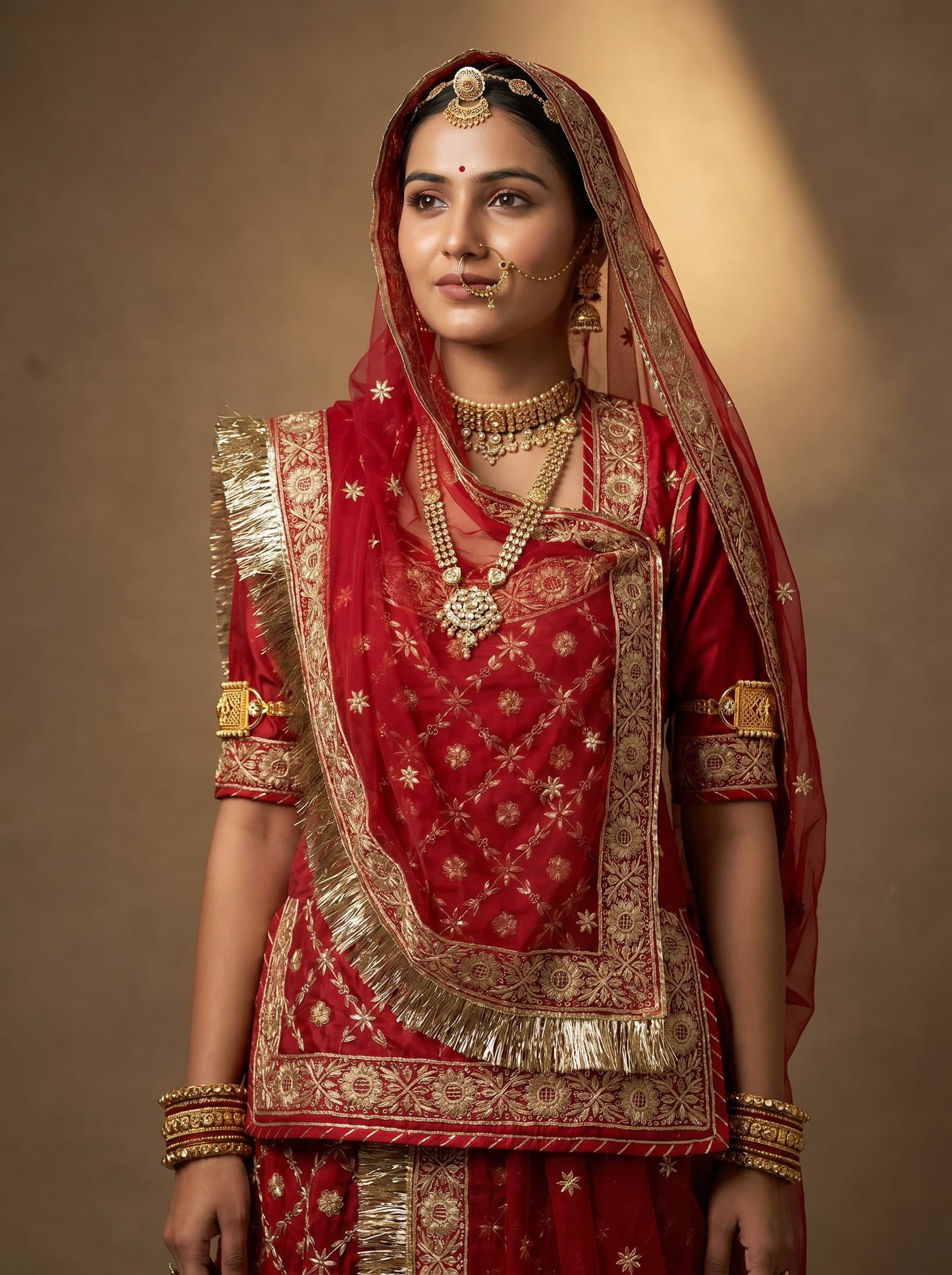
Red Bari Rajputi Poshak — Antique Zari
Editing, Pinterest boards and the DP crop
Keep the red true. That is the whole battle. Most phone edits and most preset packs push warmth, and lal turns into a tomato orange that no poshak has ever been. Pull the warmth down a touch instead and let the red sit where the dyer left it. The difference between a good red and a cheap red on screen is usually two clicks of temperature.
Go easy on the smoothing slider. It works on skin and it destroys fabric. Over-smooth a photograph and the gota loses its grain, velvet loses its nap, and the poshak flattens into a printed picture of itself.
Do not crush the blacks on velvet. Deep shadow looks dramatic on a phone screen and then, on somebody else's laptop, the lower half of the ghaghra is a black hole where five weeks of work used to be. Lift the shadows slightly. Leave the silver alone as well — a cool sheen is what real chandi looks like, and warming it up makes it look plated.
For Pinterest, export tall. A 2:3 or 9:16 crop of the fanned kali, the walk-away or the kor shot travels furthest. For a DP, crop square with the borla and rakhdi in the top third and her eyes on the upper line. The ghunghat frame works particularly well small, because it stays readable at thumbnail size when a full-length shot turns to soup.
Captions we have written about separately and at length, in Hindi, Rajasthani and English, over in our poshak captions post. One piece of advice here only: pick a caption shorter than you think it should be. Three words under a good poshak photograph beat a paragraph.
Small things that quietly spoil a poshak photograph
A hair elastic still on the wrist. It is in more finished bridal frames than anybody would believe.
The odhna slipping off the far shoulder in every third frame, unnoticed, because everyone was watching her face. This is the pin person's whole job.
Shooting only from the front. The back of a poshak carries the kanchli ties, the fall of the odhna and the full run of the kor, so half your frames should come from behind or from a three-quarter back angle.
Heavy jewellery put on at the last minute and never checked in-frame. The aad tilts, the borla chain rides up, the nath chain hooks itself the wrong way. Look at the photograph, not at the person.
Standing her under a tree at noon and thinking shade has solved it. Dappled shade is the worst light there is. It throws leaf-shaped patches across her face and across the gota, and the patches move. Full open shade, or nothing.
Handing her a bouquet. A poshak has its own language and roses are not in it. A thali, a diya, a gajra, the odhna itself, her own hands: all better.
And the last one, which is not technical at all. Shooting for forty minutes without letting her sit. A bari poshak is genuinely heavy, and tiredness shows in the shoulders long before it reaches the face. Ten minutes of work, five minutes of sitting, and a shorter day gives you better pictures.
If you want to see how different shades behave before you commit to one, the rajputi poshak collection and the real-silver pieces are photographed in the same daylight we have recommended here, so what is on screen is close to what your camera will give you. Which shade to choose in the first place is a longer argument, and we have had it here.
Frequently asked
Last reviewed: 17 May 2026 · Verified by the DivineTatva expert panel
What are the best poses for a Rajputi poshak?
Four never fail. The kali turn — turn her away, swing her back through ninety degrees, shoot in burst so the ghaghra panels open. The odhni fall, with the edge held loosely at hip height. The kor shot from behind, against a plain wall. And the seated haveli step with the ghaghra pooled forward over the step below. Add the ghunghat frame and a close crop of the borla and bangles and you have a full set. Camera at chest height for all of them.
How do I hide my face in poshak photos and still look good?
Draw the odhna forward from the centre parting until it sits just past the eyebrows, drop the chin slightly, hold the kor with both hands at collarbone height. Shoot from a touch above her eye level so light still reaches the jaw. Leave a thumb's width of face visible: the nath, the mouth, one earring. A complete blackout looks anonymous. A glimpse looks like a bride.
Which hairstyle suits a Rajputi poshak?
A centre parting is more or less compulsory, because a borla or rakhdi chain only sits straight on a proper seam — off-centre it slides and pulls at her hair all day. From there, a low juda at the nape wrapped with a mogra gajra, or one thick plait brought over the front shoulder. The juda photographs better from behind, the plait better in profile. Smooth the front sections flat and skip the teasing at the crown.
What is the best time of day for a poshak photoshoot?
Roughly 6.45 to 8.30 in the morning, or the forty-five minutes before sunset with about ten minutes after it. Low sun strikes gota and kiran from the side and gives every thread an edge. Avoid 11 AM to 3 PM. Overhead light flattens the handwork to grey and drops shadow into the eyes. A cloudy day suits velvet and deep red, and does very little for real silver.
How do I make a phone photo of a poshak look professional?
Three habits. Put her one and a half arm-lengths from a window with her body at forty-five degrees to it, or shoot outdoors in the first or last hour of light. Hold the phone at her chest height rather than your eye height. Use the 2x lens instead of stepping closer, so the poshak is not stretched at the edges. Then turn portrait mode off for full-length shots, because it eats jaali and gota edges, and shoot in burst for anything with movement in it.
What should I wear for a pre-wedding poshak shoot?
A lighter poshak is easier to carry through a pre-wedding morning than a full bari piece: a satin or georgette ghaghra with tari or danke ka kaam gives you movement without the weight. Save the heavy red for the bari frames. If two outfits are possible, do one strong shade — lal, rani pink or rama — against a plain wall, and a softer colour for the outdoor and walking frames. Jewellery kept to a borla, chooda and one neckpiece reads cleaner on camera than all of it at once.
Is real silver gota visible in photographs, or does it look the same as zari?
It looks different, and the difference is easy to lose in editing. Asli chandi gives a cooler, softer grey-white sheen. Plated zari reads warmer and glassier. Light it from one clear direction rather than under flat cloud, and do not push warmth in the edit — that single slider is what makes real silver look plated on screen.
How many photographs should we plan for in one poshak shoot?
Plan around six or seven setups rather than a number of frames: one full-length front, one back for the kor, one seated, one movement shot, one close crop of jewellery and hands, one ghunghat, one candid with something in her hands. Ten minutes of shooting and five minutes of sitting is a fair rhythm in a heavy poshak. A shorter, well-planned session gives you more keepers than a long one, almost every time.
Written in our Jhotwara workroom, mostly out of arguments we have had with photographers over the years. Seven generations of our family have made poshaks in Jaipur, and 214 karigars work on them now. A made-to-order piece takes us about thirty-eight days, and the gota you are trying to photograph spent a good part of that pulled taut on a wooden adda under a lamp. That is the only reason we care this much about where the sun happens to be standing.
If you are shooting soon and want a piece steamed, pinned and checked before the camera comes out, bring it in. Ten in the morning to eight at night, at Jhotwara and Sanganer in Jaipur, and on Link Road in Jodhpur.