Rajputi Poshak
A Rajputi poshak is four garments worn as one: the kanchli, a short fitted bodice tied at the back; the kurti that goes over it; the ghaghra, gathered from kalis; and the odhna drawn over the head. It is the wedding and everyday dress of Rajput women across Rajasthan, and it is what most people mean when they search for a rajputi poshak for women. Every piece here is cut to one woman's measurements in our Jaipur atelier rather than picked off a size chart, with the handwork done by our karigars on wooden addas over about thirty-eight days. Prices begin near Rs 20,400 and rise with the fabric, the kali count and the weight of real silver in the gota.
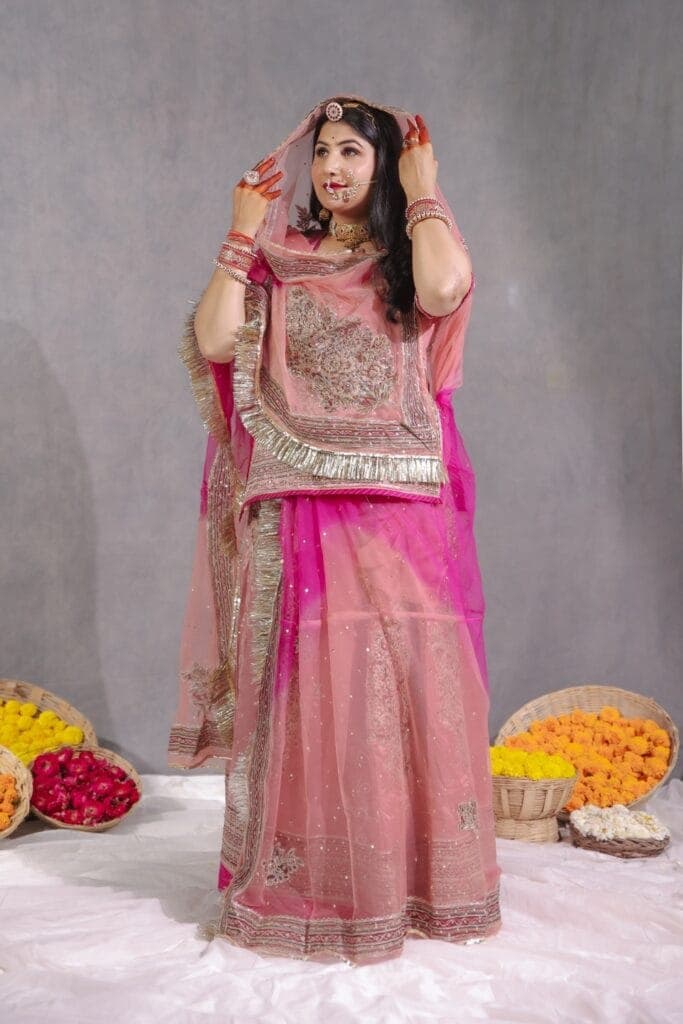
Designer Baby Pink Rajputi Poshak
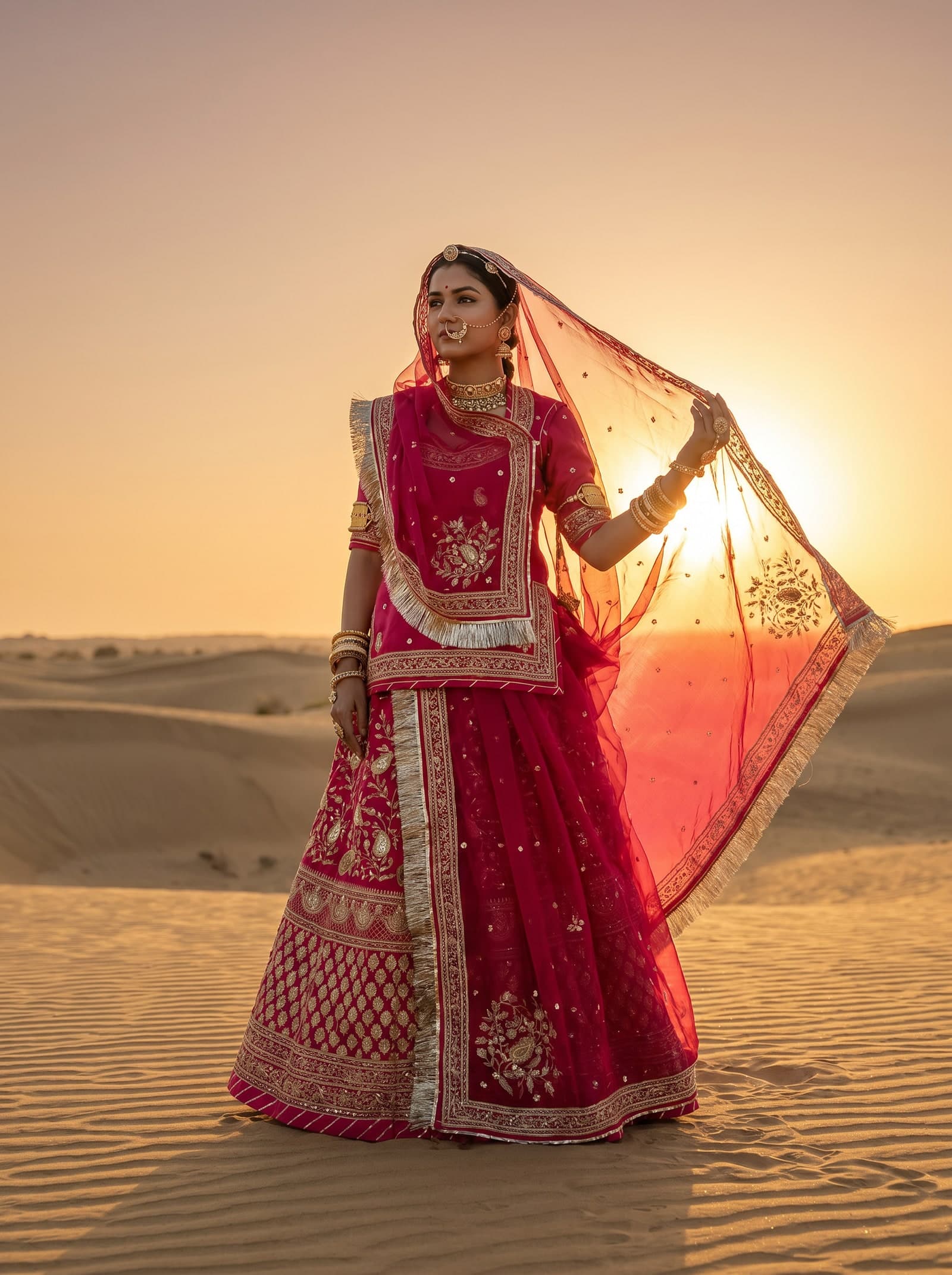
Rani Pink Bari Rajputi Poshak — Aari Zardozi
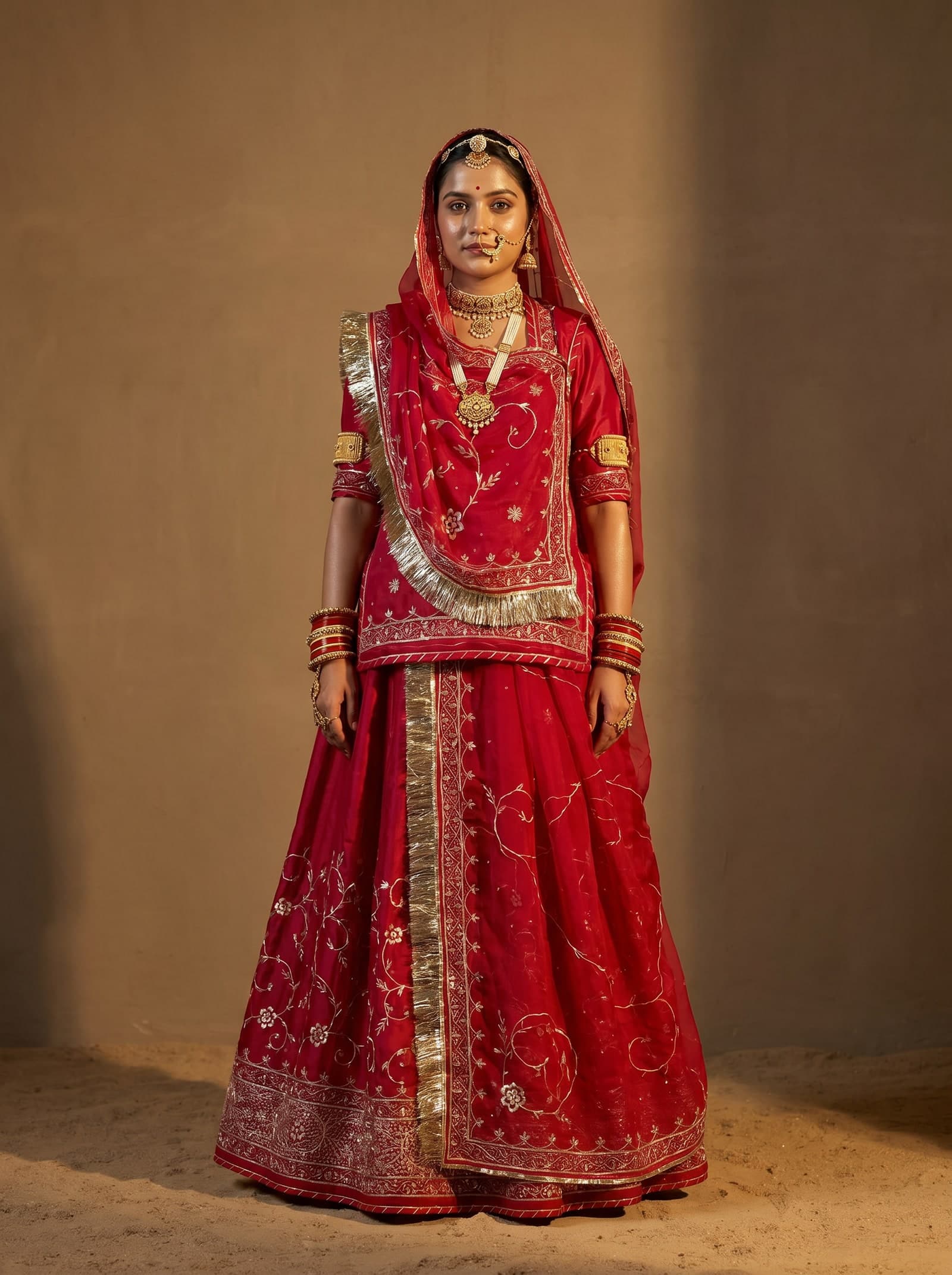
Red Bari Rajputi Poshak — Dabka
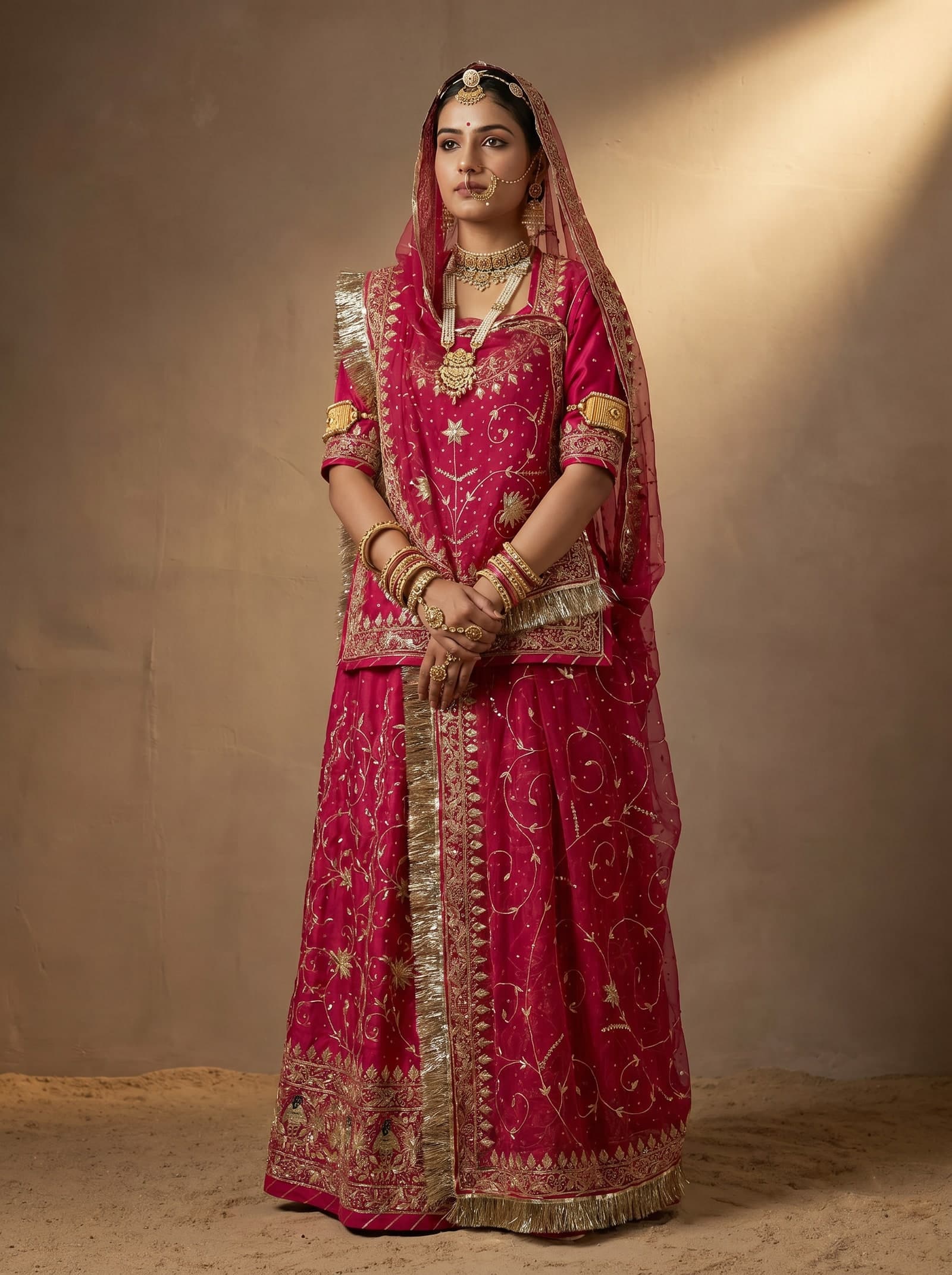
Rani Pink Bari Rajputi Poshak
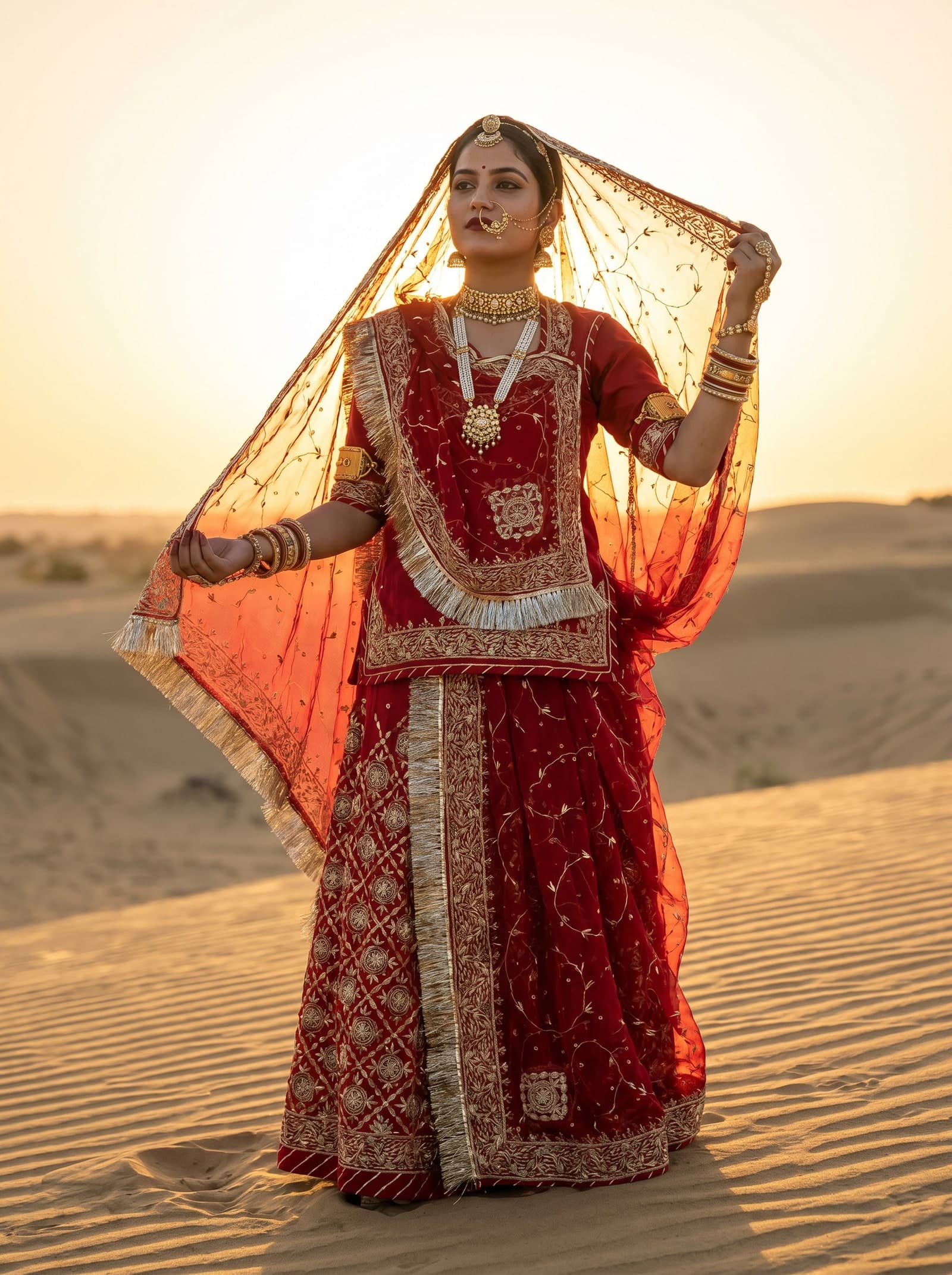
Deep Red Velvet Bari Rajputi Poshak
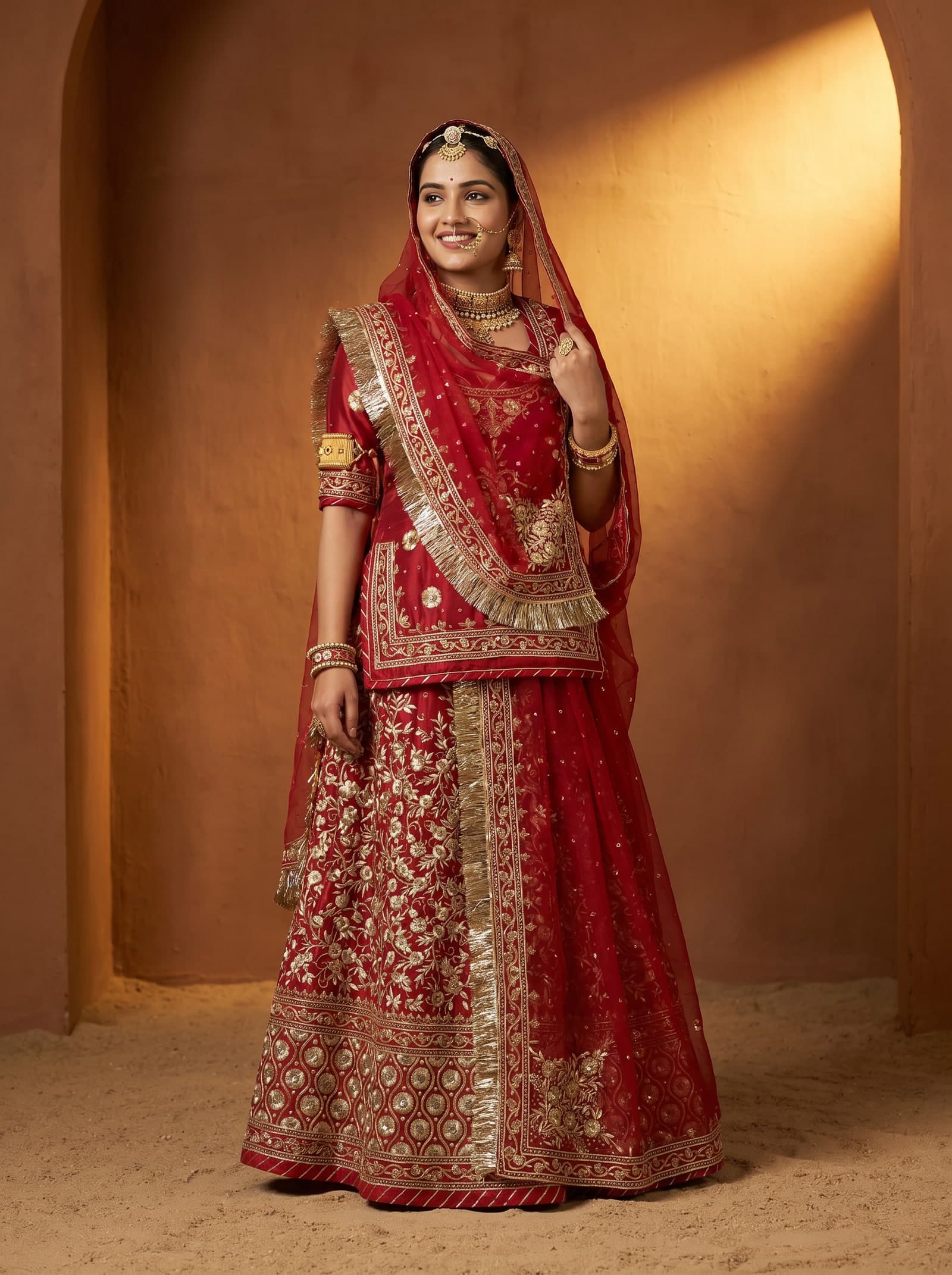
Red Bari Rajputi Poshak — Zari Jaal
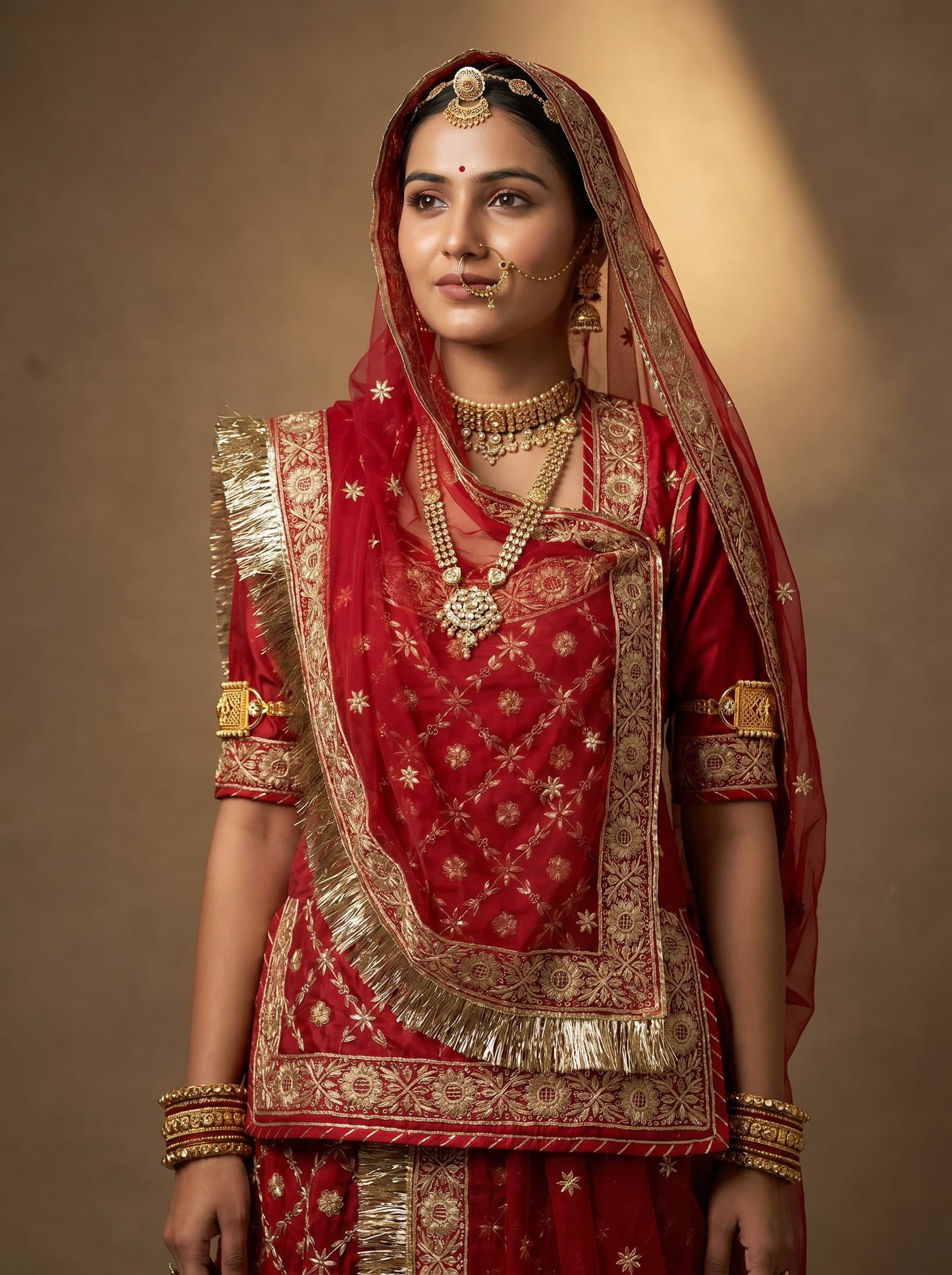
Red Bari Rajputi Poshak — Antique Zari
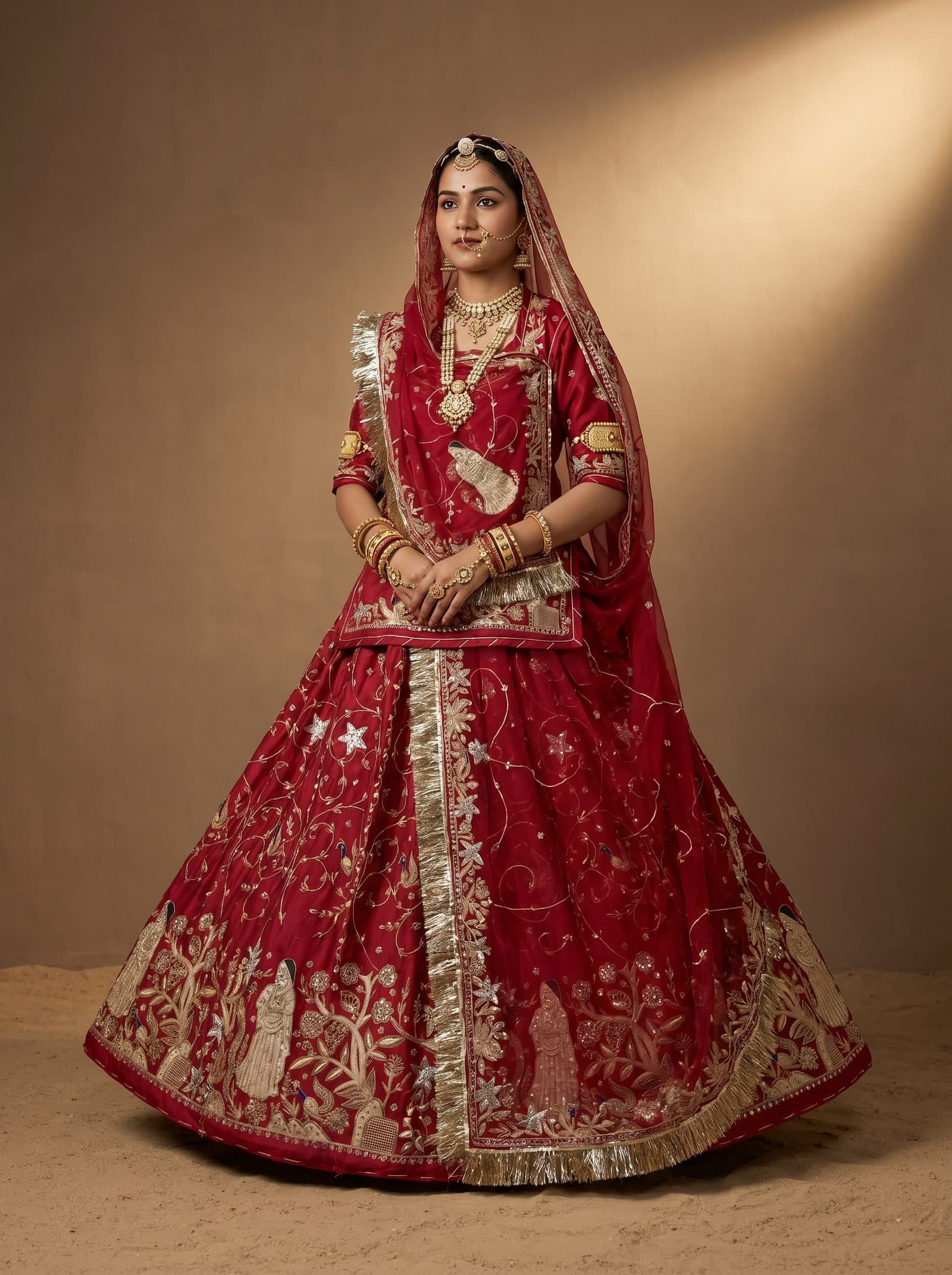
Red Bari Rajputi Poshak — Pichwai Motif
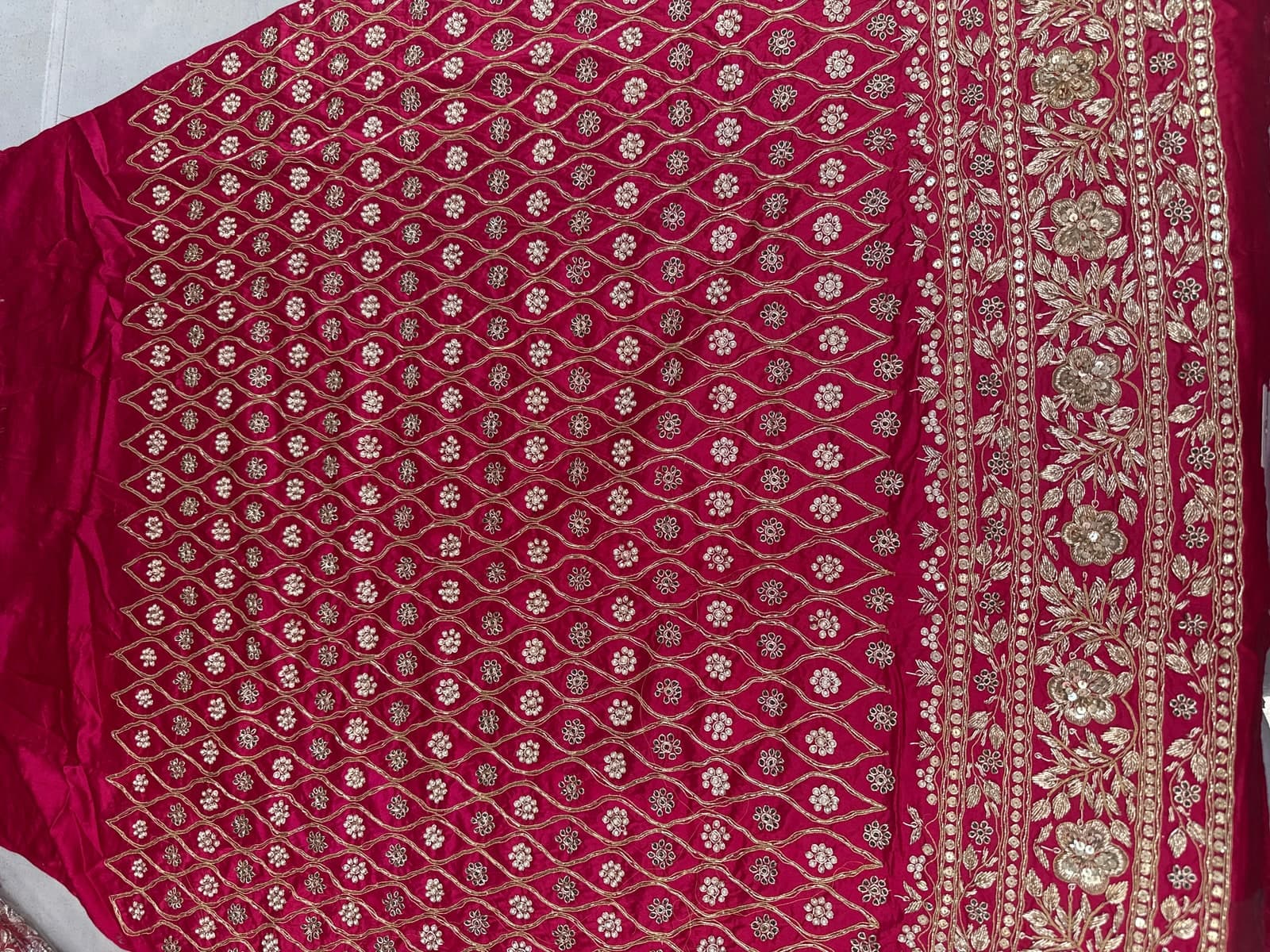
Rani Pink Bari Rajputi Poshak — Gota Jaal
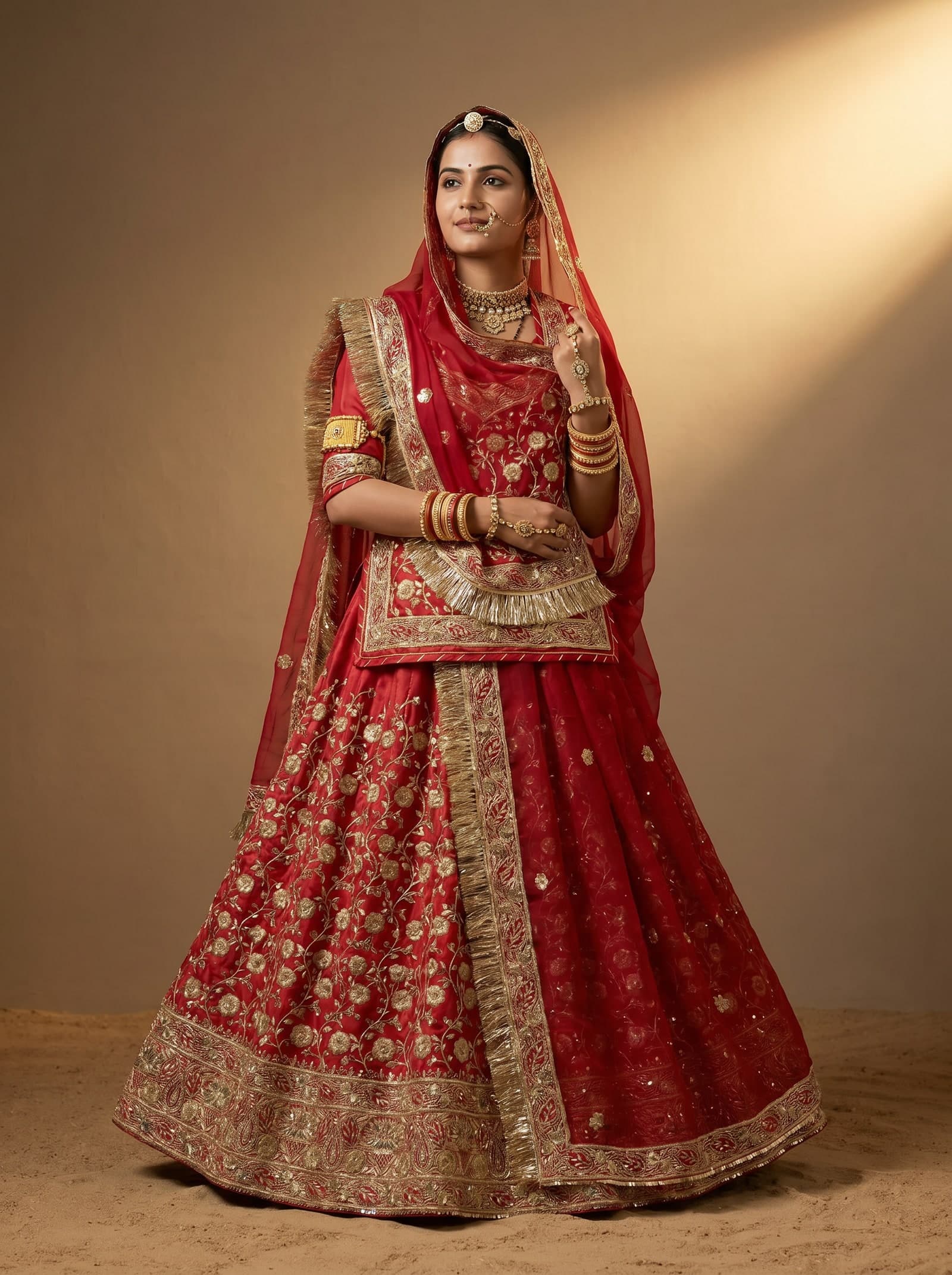
Red Bari Rajputi Poshak — Floral Zari
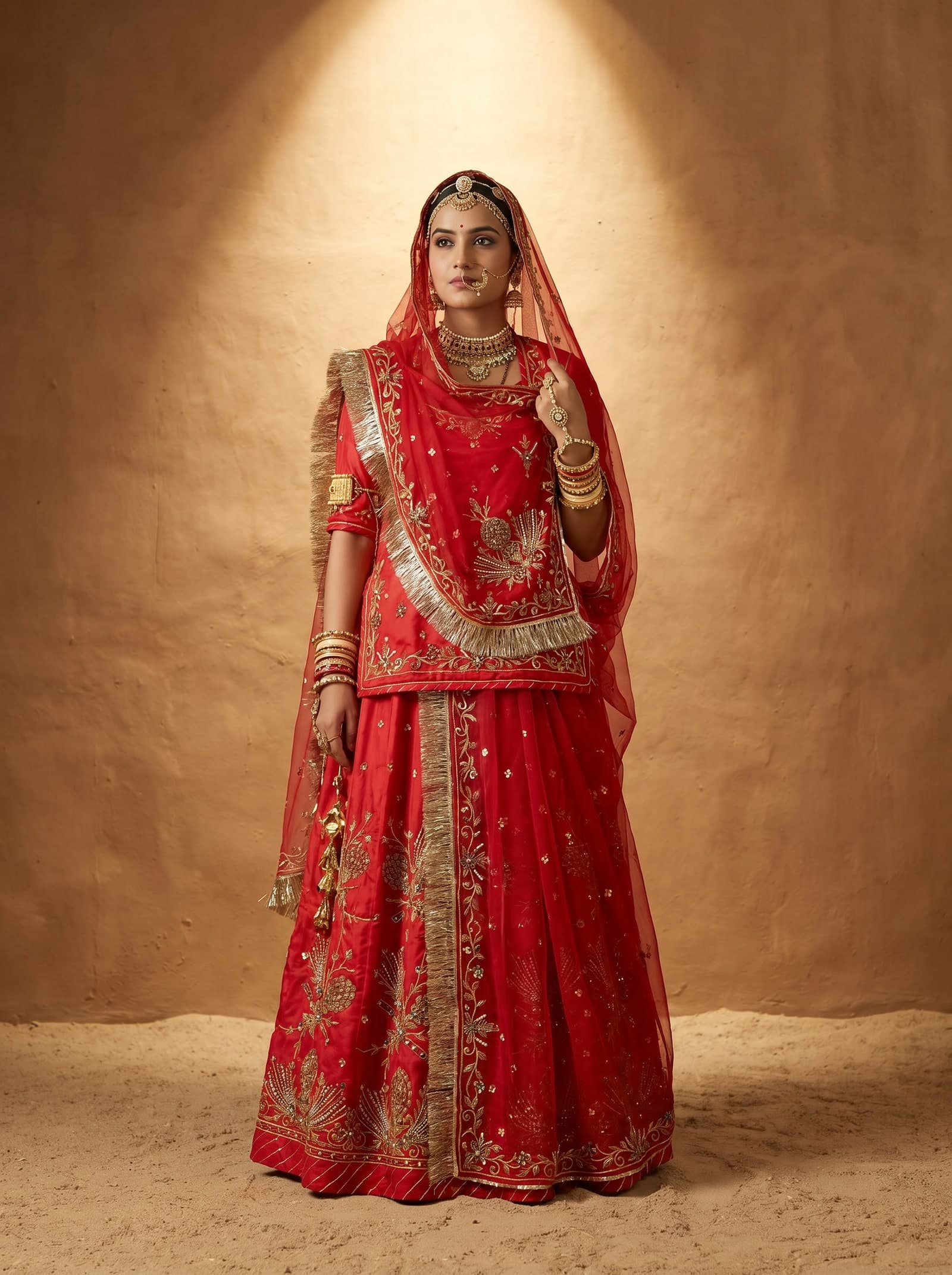
Scarlet Red Bari Rajputi Poshak
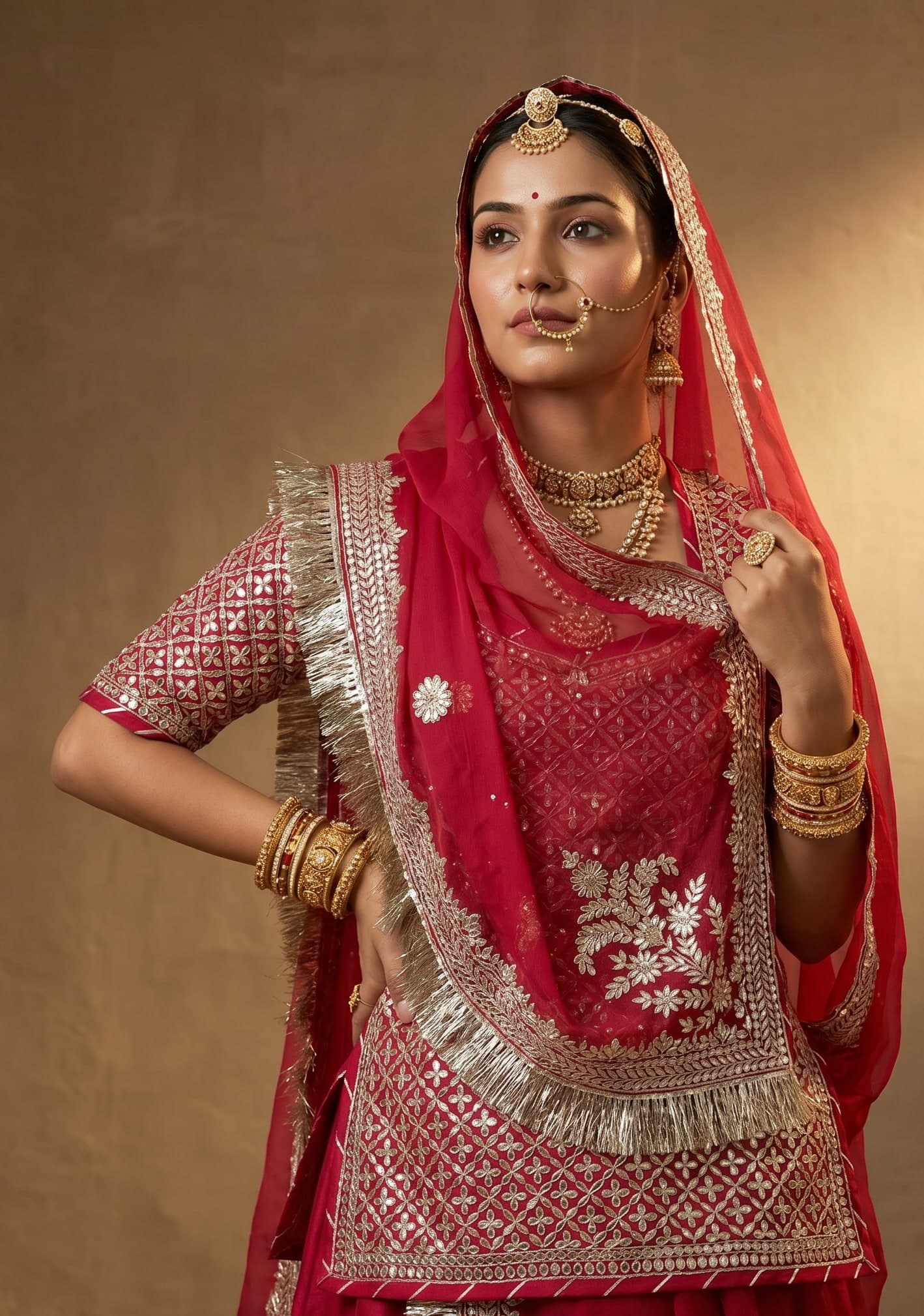
Red Bari Rajputi Poshak — Gota Patti
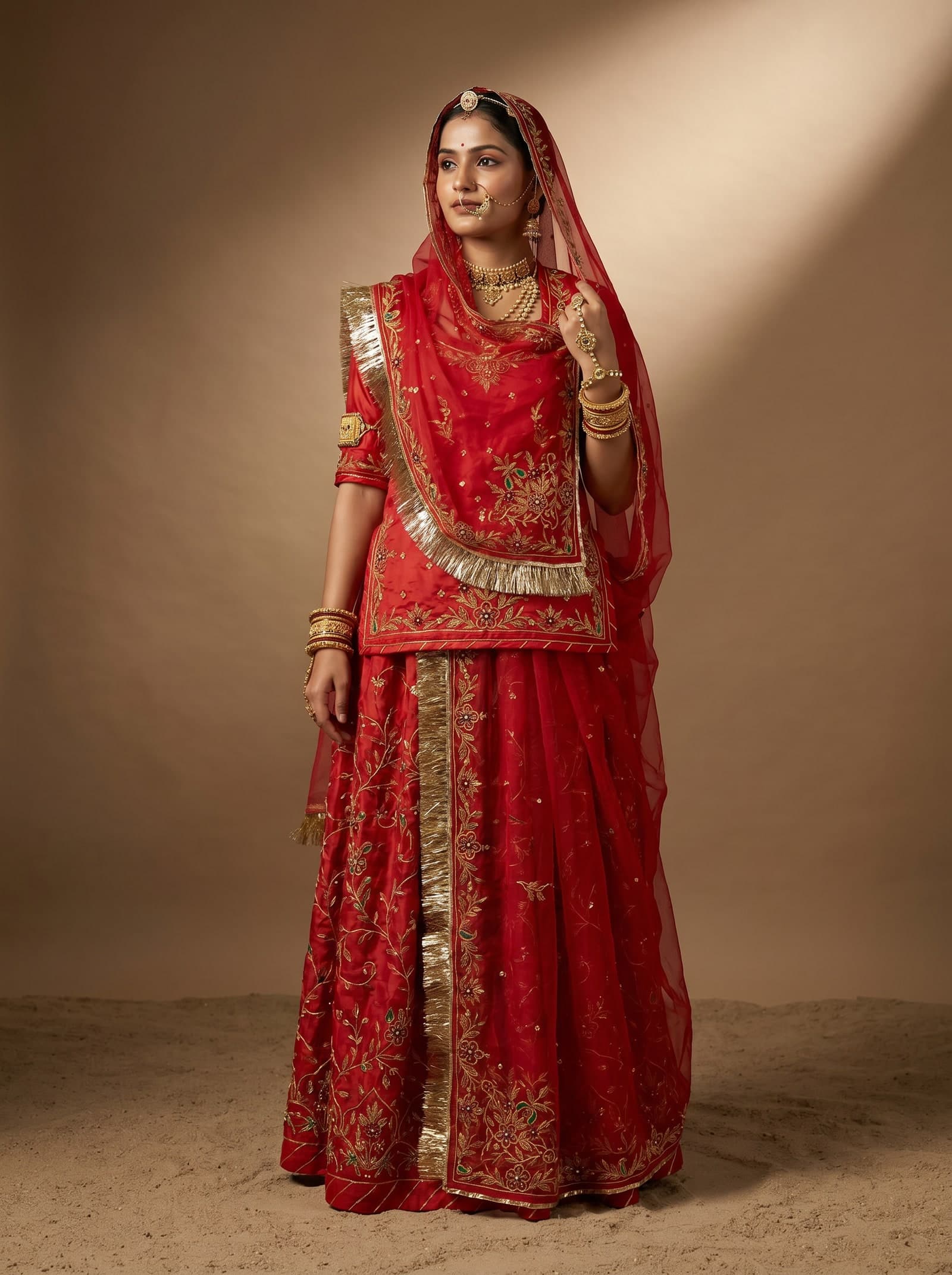
Red Bari Rajputi Poshak — Antique Samla & Dori Jaal
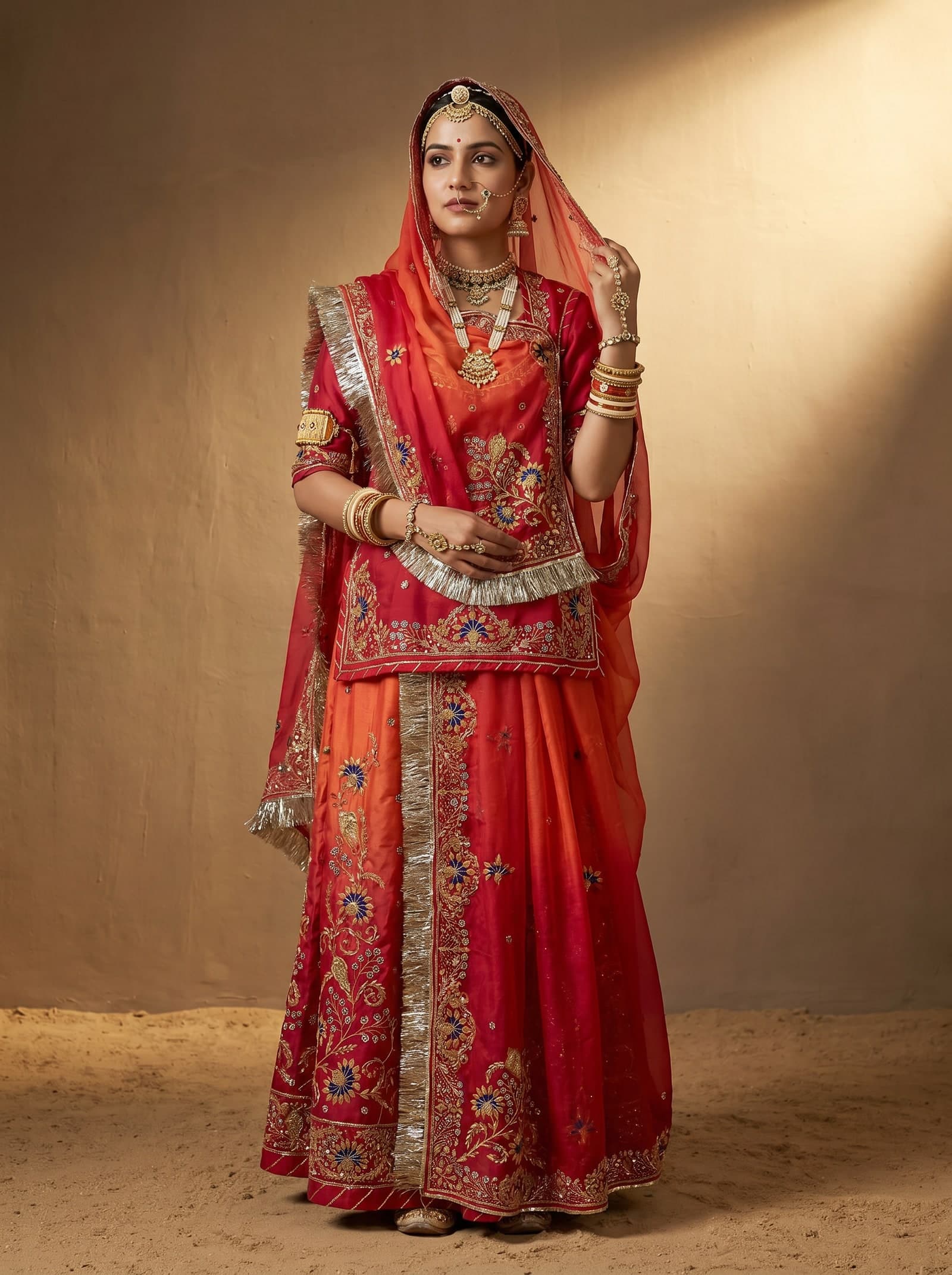
Red-Orange Shaded Bari Rajputi Poshak — Golden Dabka
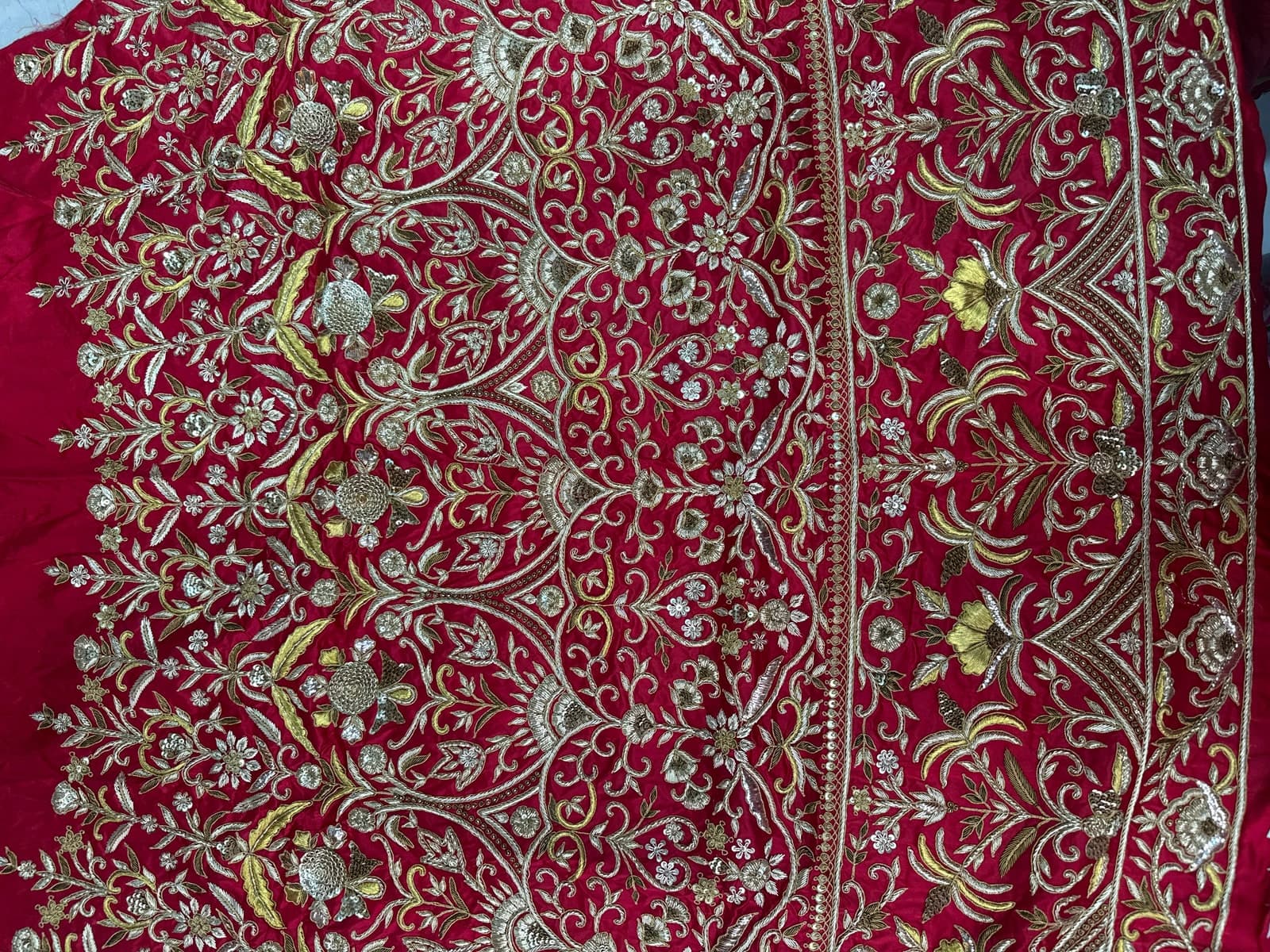
Crimson Bari Rajputi Poshak — Antique Golden Zari
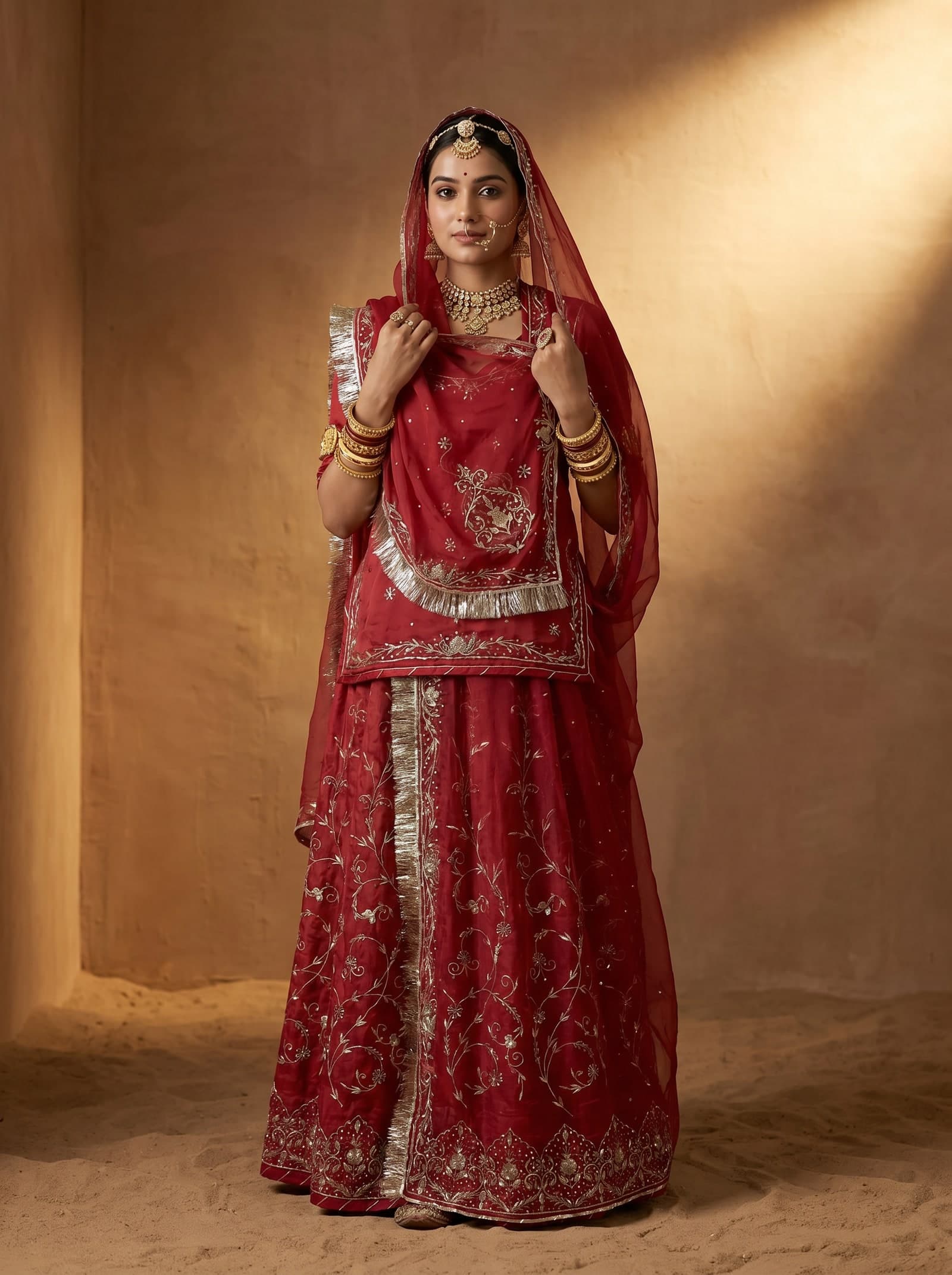
Red Bari Rajputi Poshak — Dabka & Dori Jaal
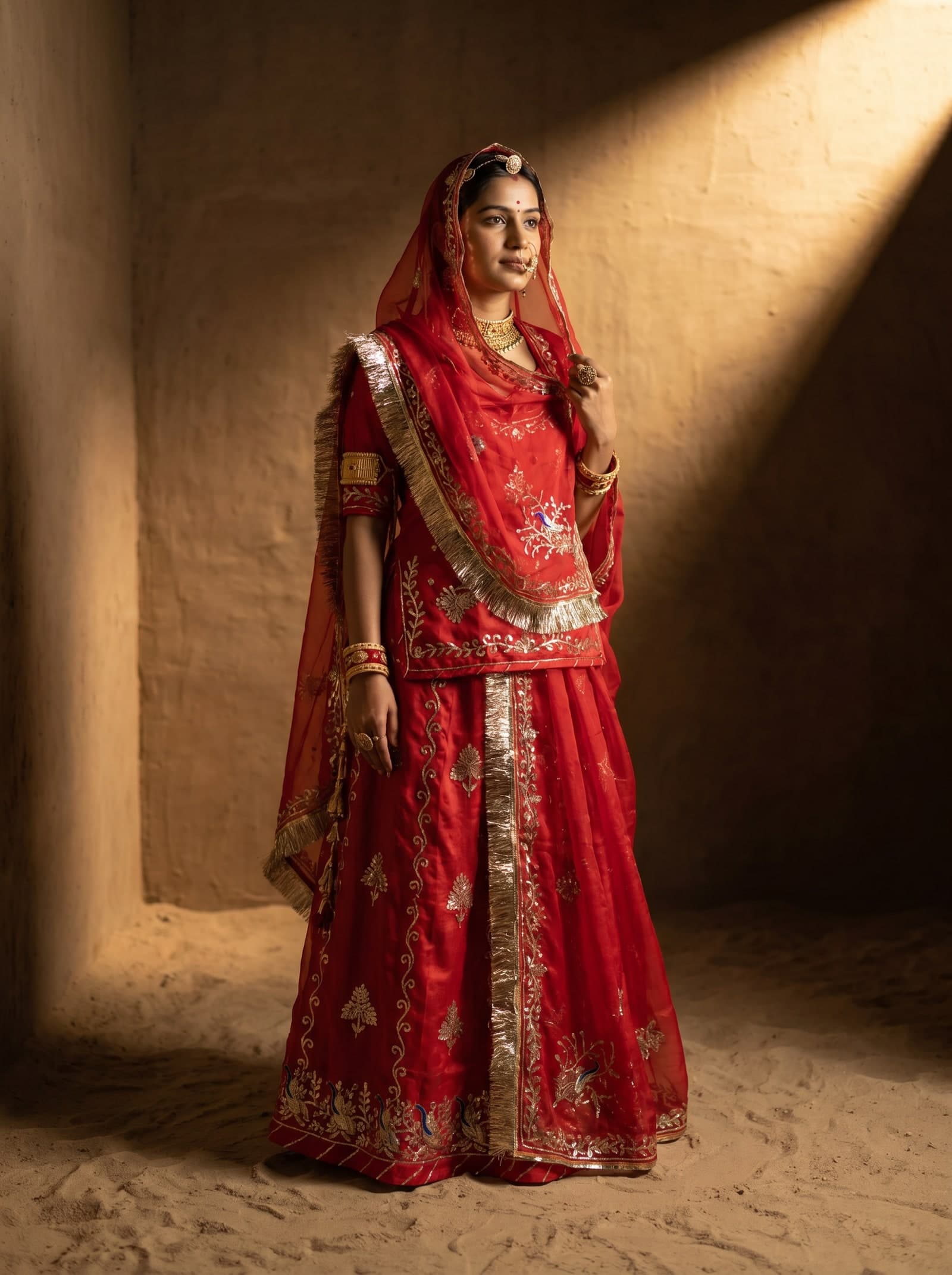
Scarlet Red Bari Rajputi Poshak — Aari Tari
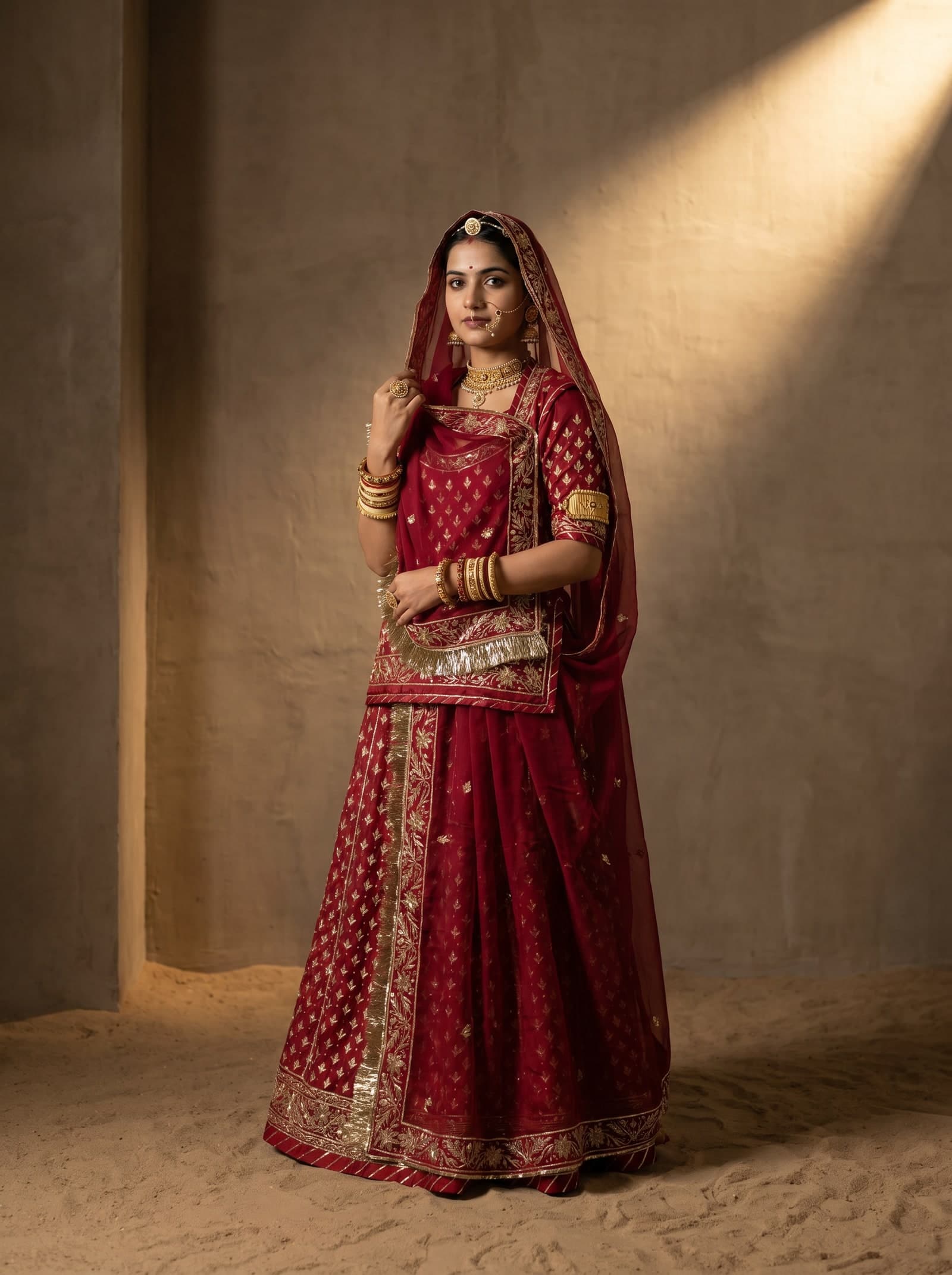
Deep Red Bari Rajputi Poshak — Dabka
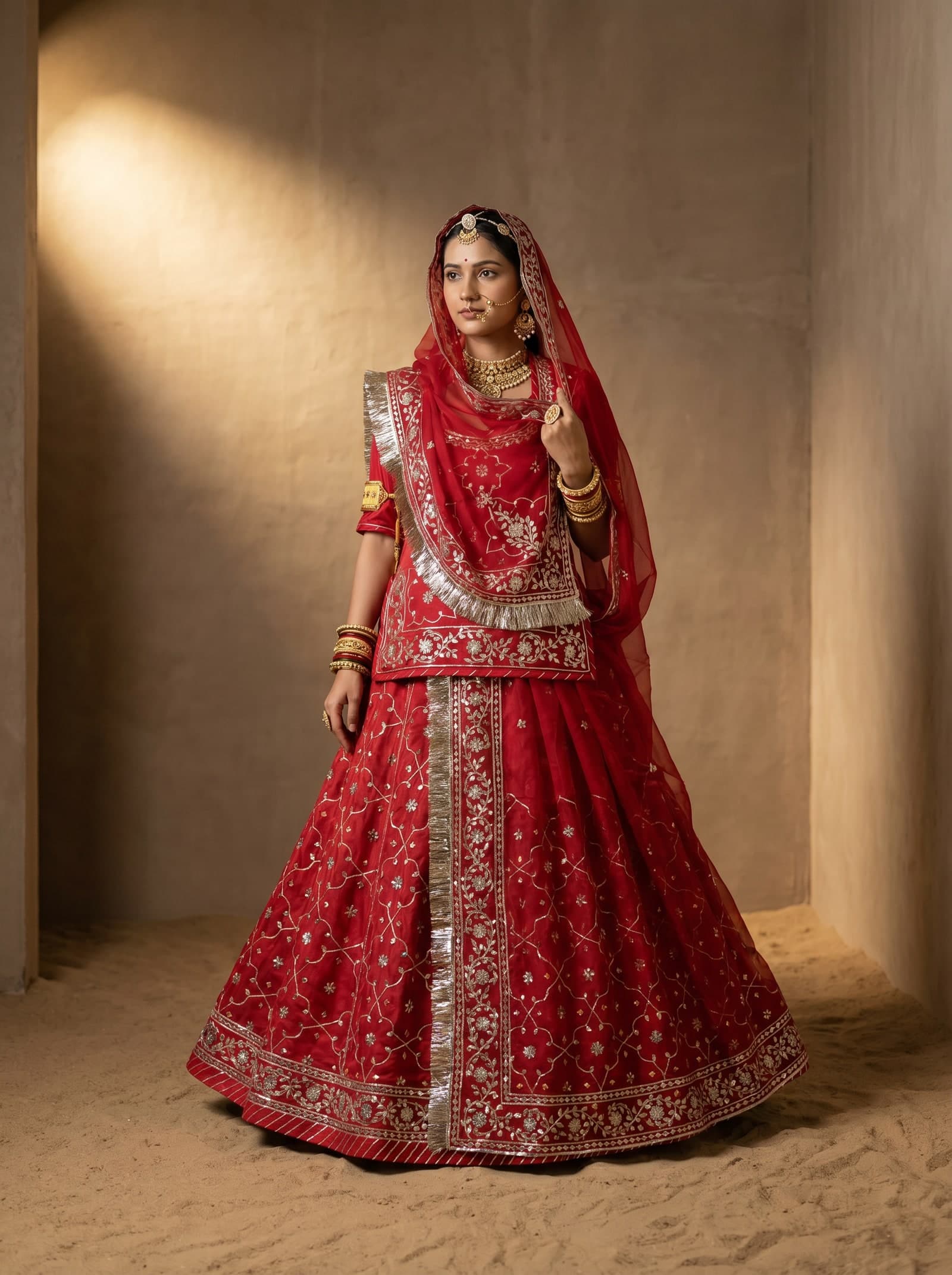
Red Bari Rajputi Poshak — Kachi Patti & Copper Sikhiya
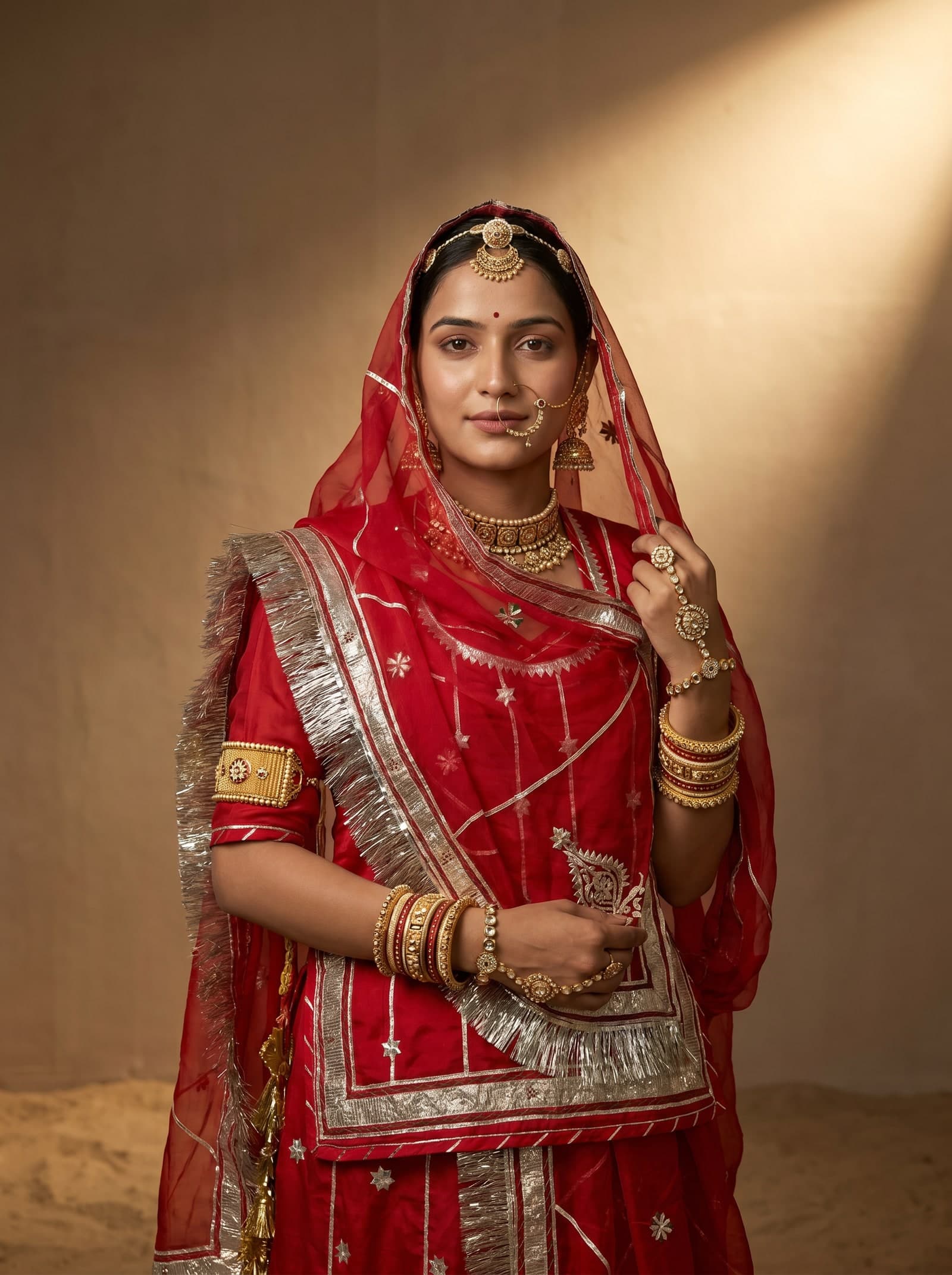
Red Bari Rajputi Poshak — Copper Lappa & Kachi Patti
Four garments, worn as one
The kanchli goes on first: short, close-cut, tied at the back rather than hooked, usually left plain but for a thin magji finishing the edge. Over it comes the kurti, open at the front and shorter than a kameez. Most of the visible handwork sits here, on the yoke, down the fall of the sleeve, along the kor at the hem. Then the ghaghra, gathered from kalis, the tapered panels that decide how a skirt turns. Twelve kalis make a poshak she can wear through a whole evening. Twenty-four make a bridal ghaghra with so much cloth in it that two of us hold it open while it is pressed. Last is the odhna, roughly two and a half metres, taken over the head so the worked kor frames the face, the heavy corner carried forward across one shoulder.
Online the same garment gets listed as a poshak dress, a Rajasthani poshak for women, a rajputi dress for women. One thing, many names. The shape itself is old. Kanchli, kurti, ghaghra and odhna show up in Rajasthani miniature painting, and in the photographs our family keeps of women standing in haveli courtyards in Jaipur and Jodhpur, dressed close to the way we cut today.
Poshak or lehenga
A lehenga choli is two pieces and a dupatta. A poshak is four, and the piece that separates them is the kurti, that open layer over the kanchli, for which a lehenga has no equivalent.
The drape differs as well. A dupatta rests on the shoulder or over the forearm. An odhna goes over the head with one end tucked into the ghaghra at the waist, and it is built to stay put through the saat phere without anyone reaching up to fix it. The ghaghra is softer than a stitched lehenga skirt too: gathered on a nada, no zip, no boning, hemmed to the ankle so the mojari shows when she walks. If a shop tells you a poshak is a Rajasthani lehenga, what you are being sold is a lehenga.
The types, and what each one is for
The heaviest work goes into bari poshaks, worn for bari, phera and milni. Red leads and always has. Fifteen depths of lal sit on our shelves at the moment, rani pink beside them, and one shaded red-orange we cut for a bride who wanted the colour of the sky over Jodhpur at seven in the evening.
Festive poshaks run lighter. Piliya and aam-pila yellows for Teej and Gangaur, lehriya and bandhej for faag, rama green and firozi for the sangeet nights and the visits in between. Then there is everyday wear, which nobody photographs and everybody owns: mulmul cotton, a small block print, one line of gota at the kor and nothing more. A simple rajputi poshak survives a Jaipur June. A laffa one does not.
Fabric decides how a poshak behaves. Chiffon floats and photographs well, though it wants a proper lining under it. Laffa holds shine and weight, which is why so many bari poshaks are cut from it. Satin sits smooth and reads richer than it costs. Silk and velvet come out for winter weddings. Cotton is for living in.
The work is the other axis. Dabka and zardozi build a raised, dense surface. Aari-tari and treshing draw fine lines, the hook working from under the cloth while the karigar's left hand feeds thread he cannot see. Gota-patti and gota-kiran run the borders. Danka lies flat in small geometric plates and throws light clear across a room. Mukesh, dotted through a plain ground, looks like nothing at all until she moves. And then our own stubbornness: asli chandi gota, real silver drawn to wire, flattened between rollers into ribbon, then worked by hand into the kor and the buti. It costs what it costs, and it behaves like metal because it is metal. Everything cut that way sits together under real-silver poshaks.
Choosing the shade
Colour here is instruction, not decoration. Lal for the phera. Piliya for the ceremonies leading up to it. Rama green when a young wife goes visiting, firozi and sky blue for the lighter days, white kept away from weddings altogether. Tell us the ritual and the month and we will narrow the shade before you have looked at a single swatch.
One practical thing about dye: wet cloth reads about two shades darker than dry. We match a dried snip at the window in daylight, never under a tubelight at nine at night, which is how brides end up with a red nobody chose. If a lot comes up cold against her sample, it goes back into the vat.
Measurement, and where the thirty-eight days go
We ask for a longer list than most. For the kanchli: upper chest, full chest, under-bust, waist, shoulder width, armhole, sleeve length, sleeve round, front and back neck depth, and kanchli length. For the kurti: its length and its own sleeve. For the ghaghra: waist, hip, kali count, and the full waist-to-floor length taken in the heel she actually intends to wear on the day, not the flat one she came in. Then the odhna. Across the counter at our Jaipur shops or in Jodhpur this takes ten minutes. From further off, courier us one kanchli that already fits her well. That single garment tells us more than any chart she fills in.
The thirty-eight days are not padding. Fabric is dyed to her shade. Kalis are cut from a paper pattern and joined, and the seams are matched so the print does not step at the joins. The pieces then go onto the adda, a wooden frame with the cloth pulled drum-tight, and stay there under a lamp while a karigar works the yoke and the kor by hand. On a heavy bari poshak that stage alone can run three weeks, one man, one frame. After it: magji, lining, finishing, a press that leaves the whole room smelling of hot starch, the number stitched in with our signature, the trousseau box. Rush any of it and you can see exactly where it was rushed.
Kaise pehnate hain
Kanchli first, tied at the back, snug without gripping. Kurti over it, front left open. The ghaghra is tied with the nada and the knot pushed inward so it makes no bump under the kurti. For the odhna, take the plain end, tuck a hand's width into the ghaghra at the left waist, carry the length round the back, bring the worked corner forward over the right shoulder, then lift the kor over the head so it settles an inch behind the hairline. A borla or rakhdi holds it at the parting. One small pin at the shoulder is enough; pin it in three places and the drape stops moving with her. Aad, bajuband and kamarbandh go on after the odhna is set, never before.
Jad banni saji-sanwri, the last thing anybody fixes is the kor. Leave her a minute alone at the mirror before the milni.
Care, which most people get wrong
Fold it. Never hang it. Gota and dabka are heavy, and a hanger will drag the shoulder line out of shape inside one season. Lay muslin between the folds, especially over raised work. Store in cloth rather than plastic, which traps damp and marks zari.
Do not send handwork for routine dry-cleaning. Solvents flatten gota and dull real silver, and most counters will not warn you. Spot-clean small marks instead. Iron on the reverse, with a cotton cloth over the work. Keep camphor and naphthalene well away from anything silver.
Asli chandi darkens over the years, which is silver doing what silver does. A soft dry cotton cloth and a gentle rub brings it back. Twice a year, open the box, let the poshak breathe for an hour and refold it along different lines so the creases never set into the cloth.
What it costs, without the theatre
Our bari poshaks currently run from Rs 20,400 to Rs 94,500, and the heaviest commissions in the house go past Rs 2,00,000. Five things move the number: metres of fabric, kali count, how densely the surface is worked, the karigar days that work eats, and the weight of silver if she has chosen asli chandi. Silver is bought by weight, so it moves with the market. We quote it separately rather than burying it in a round figure.
A twelve-kali cotton poshak with a light kor is genuinely inexpensive and always will be. A twenty-four-kali laffa bari with silver gota across the odhna is a month of one man's hands, and most of what you pay is his. We do not discount. We would sooner explain a number than shave it. To see how the pieces add up before you speak to anyone, use the poshak price calculator.
Ordering, from Jaipur or from far away
Three shops. Jhotwara and Sanganer in Jaipur, and one in Jodhpur off Link Road, all open ten to eight. If you can come in person, come in the morning; the light is better for judging shade, and the counters are quieter before noon. Swatches and shade photographs go out on WhatsApp before anything is cut, and nothing is cut until she has confirmed the colour on screen and, where there is time, in hand.
We ship across India and to 42 countries. Every piece leaves numbered and signed, packed in the heritage trousseau box, with the karigar's work on it finished the way it left the adda. If you are unsure where to begin, send us the wedding date first. Thirty-eight days is a comfortable run; it is not a lot of room if the date is in six weeks.
About Rajputi Poshak
What is a Rajputi poshak?
The traditional four-piece dress of Rajput women in Rajasthan: kanchli, kurti, ghaghra and odhna, worn together. The kanchli is the fitted inner bodice, the kurti the open layer over it, the ghaghra a gathered skirt made from kalis, and the odhna the long veil taken over the head. It is worn for weddings, for Teej and Gangaur, and in lighter cotton versions at home.
Rajputi poshak ko English mein kya kahate hain?
There is no exact English word for it. The closest is 'traditional Rajasthani four-piece dress', though most people write it as poshak dress, Rajasthani poshak for women, or Rajputi dress for women. Kanchli translates loosely to bodice, kurti to a short open tunic, ghaghra to a flared skirt, odhna to a veil. We keep the Rajasthani names because the English ones lose the cut.
What are the four pieces of a poshak?
Kanchli, kurti, ghaghra, odhna. The kanchli sits closest to the body and fastens at the back. The kurti goes over it, open at the front, carrying most of the handwork. The ghaghra is the skirt, made of kalis: twelve for lighter pieces, twenty-four for bridal. The odhna is roughly two and a half metres of fabric with a worked kor along the border.
What is the price of a Rajputi poshak?
Our bari poshaks run Rs 20,400 to Rs 94,500 at present, and heavier commissioned pieces go beyond Rs 2,00,000. Cotton and daily-wear poshaks sit well below that. The price is driven by fabric, kali count, density of handwork, karigar days, and silver by weight when you choose asli chandi gota. Our price calculator breaks it down before you speak to anyone.
What is the difference between a poshak and a lehenga?
A lehenga choli is two pieces plus a dupatta. A poshak is four, and the extra one is the kurti worn over the kanchli. The odhna is draped differently as well, over the head and tucked at the waist rather than resting on the shoulder. The ghaghra is gathered on a nada with no zip, so it moves more softly than a stitched lehenga skirt.
How is a poshak measured, and how long does it take?
We take upper chest, full chest, under-bust, waist, shoulder, armhole, sleeve length and round, front and back neck depth, kanchli and kurti lengths, ghaghra waist and hip, and the full skirt length in the heel she will actually wear. Then the kali count and the odhna length. Stitching and handwork take about thirty-eight days. If you cannot reach a shop, courier us one kanchli that already fits you; it is far more reliable than a written chart.
Which colours do you make?
Red in many depths is the heart of the collection, fifteen shades of lal among the bari poshaks right now, with rani pink, one shaded red-orange, a designer baby pink and a marigold-yellow floral suit. On order we work rama green, firozi, sky blue, white, elaichi, brown and the piliya yellows used for Teej and Gangaur. Tell us the ritual and we will tell you which shades belong to it.
Do you make cotton and daily-wear poshaks?
Yes. Mulmul and fine cotton, small block prints, a single line of gota at the kor and nothing heavier. They are cut on the same measurements as a bridal poshak, with fewer kalis and far less time on the adda. Most families who order a bari from us come back for two or three cotton ones, because those are the poshaks that actually get worn.
How do I wash and store a Rajputi poshak?
Fold it, never hang it; the weight of gota pulls the shoulder line out within a season. Put muslin between the folds and store it in cloth, not plastic. Spot-clean marks rather than sending handwork for routine dry-cleaning, since solvents flatten gota and dull real silver. Iron on the reverse through a cotton cloth. Keep camphor and naphthalene away from silver, and air the poshak twice a year, refolding along fresh lines.
Do you ship outside Rajasthan?
We ship across India and to 42 countries. Orders are taken on WhatsApp at +91 98290 17524 or through concierge@grandabhaneri.com, and swatches with shade photographs go out before anything is cut. For customers we have not measured across a counter, we ask for one well-fitting kanchli by courier first. Pieces travel numbered and signed in the same heritage trousseau box.
Where are your shops?
Three. Jhotwara, Jaipur: Shop 7, Khatipura Road, opposite Goverdhan Sky, Fateh Colony, Indrapura, 302012, phone +91 77424 58740. Sanganer, Jaipur: 210, Swami Vihar, Shiv Shakti Nagar, 302019, phone +91 98290 24503. Jodhpur: Gali No. 33, 7, Link Road, near Ramdev Vatika and the RTO office, BJS Colony, 342006, phone +91 96363 66904. All open 10 AM to 8 PM.
What is a real-silver poshak?
One where the gota is asli chandi: silver drawn into wire, flattened into ribbon, then worked into the kor and the buti by hand. It is heavier than plastic-film gota, warmer in tone, and it ages instead of peeling. It darkens over the years, which is normal, and a soft dry cotton cloth restores it. This is the work our house is known for, and we quote the silver by weight so you can see what you are paying for.