Rajasthani Dress for Women: 9 Traditional Outfits, Named & Priced
The traditional Rajasthani dress for women is the poshak — a four-piece ensemble of kanchli, kurti, ghaghra and odhna — though the word covers a whole family of outfits that change with caste, season and occasion. A Marwari trader's wife, a Rajput thakurani and a farmer's daughter in Shekhawati have never dressed identically, and that is half the beauty of it.
We cut and embroider these clothes every day in our Jaipur workshop, so this guide comes from the cutting table, not from a costume encyclopedia. Every outfit below is named the way we actually name it, with the occasion it belongs to and an honest word on what it costs.
The poshak — what a Rajasthani dress actually is
Strip away the regional variations and a Rajasthani woman's dress is four pieces. The kanchli, a fitted inner bodice, cut close and hooked at the back. The kurti, worn over it, ending near the waist. The ghaghra — the great skirt, stitched in panels called kali; the more kali, the fuller the swing, and a heavy bridal ghaghra can run past twenty-four. And the odhna (you'll also hear odhni), the veil that carries much of the visible work and most of the meaning.
When all four are cut from matching cloth and worked as one set, that is a Rajputi poshak — the most formal expression of Rajasthani dress, and the one this house has built for seven generations.
Everything else in this guide — lehriya, bandhej, faganiya — is a variation in cloth, dye or occasion on this same four-piece skeleton.
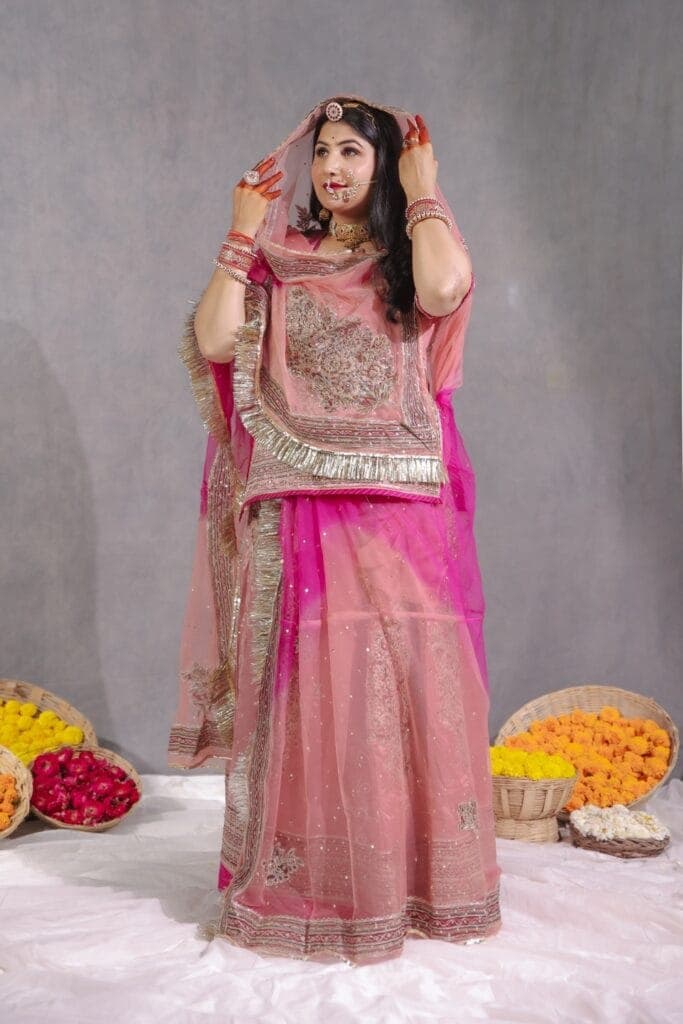
Rajasthani dress names, and when each is worn
Keep this table handy — these are the names shopkeepers, tailors and grandmothers actually use.
| Rajputi poshak | The formal four-piece set — weddings, festivals, mehfils |
| Bari poshak | The bridal poshak, worn for the phere; almost always lal |
| Ghaghra-kanchli | The everyday skirt-and-bodice, lighter cloth, lighter work |
| Lehriya | Wave-dyed cloth of Sawan and Teej — the monsoon's own print |
| Bandhej (bandhani) | Tie-dyed dots; festive, auspicious, worn across communities |
| Faganiya | The white-ground, red-flecked dress of Holi and Faag season |
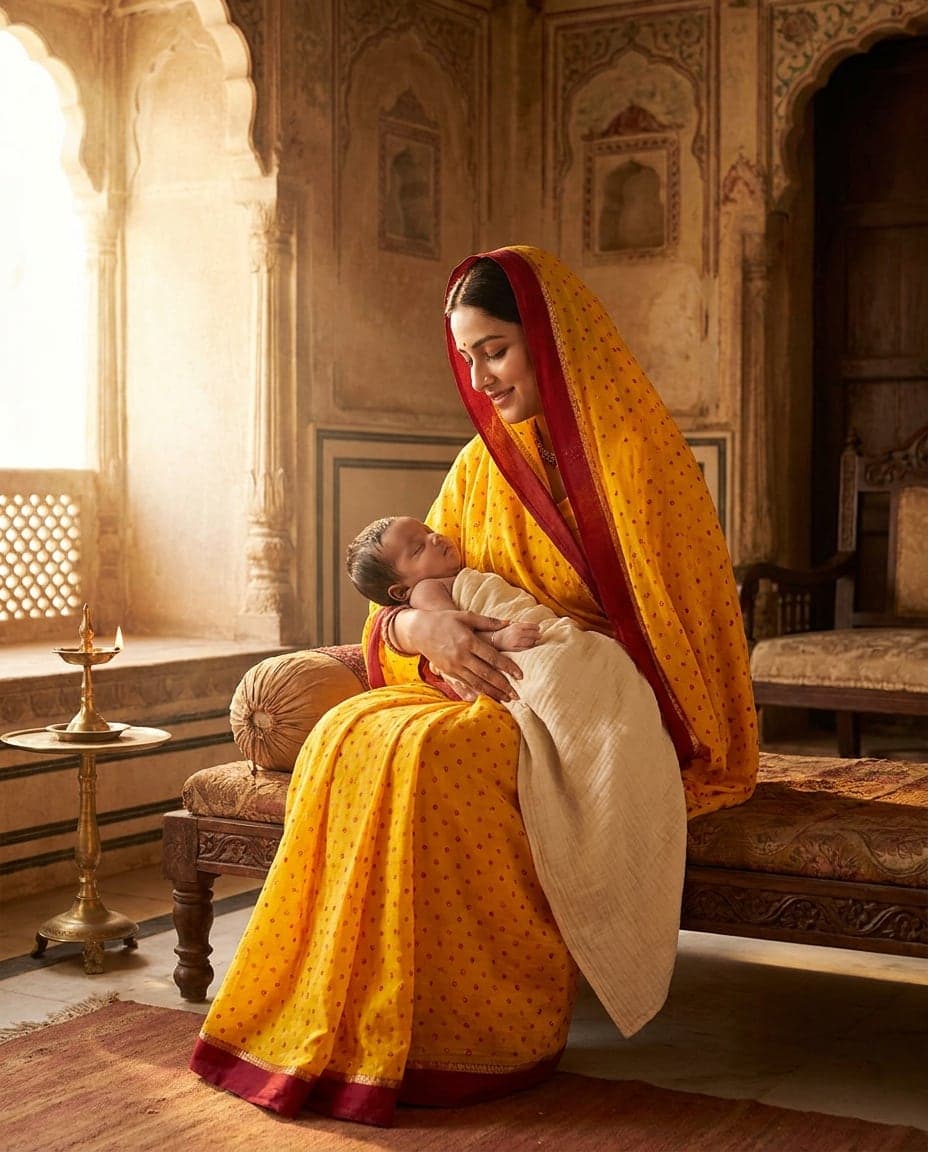
| Piliya | The yellow odhna worn by a new mother — announced, not explained |
| Mothda | Diagonal-check lehriya, the connoisseur's variant |
| Kota doria | Featherweight open-weave cloth for the hot months |
The seven outfits you'll actually see in Rajasthan
- 01The bridal bari poshak
Red, fully worked in dabka or zardozi, gifted by the groom's family and worn for the phere. The heaviest and most remembered dress a Rajasthani woman owns. We've written a full guide to the bari poshak separately.
- 02The festive Rajputi poshak
For Teej, Gangaur, weddings on the guest side. Satin or silk base, gota and aari-tari work, in rama, firozi, lal or pila. This is the poshak most of our pieces are.
- 03The everyday ghaghra-kanchli
Cotton or light satin, minimal work, built for heat and housework. What most of Rajasthan wears most of the year — and what tourists rarely see photographed.
- 04Lehriya for Sawan and Teej
The wave-dye arrives with the monsoon. A lehriya odhna over a plain poshak is the correct July-August look in Jaipur; on Teej it is nearly a uniform, and nobody minds.
- 05Bandhej for festivals
Thousands of tied dots, dyed and opened. Worn across Rajasthan by every community, which makes it the most democratic cloth in the state.
- 06Faganiya for Holi season
White ground scattered with red — worn through Faag, when the whole state loosens up. If you own one Rajasthani dress for spring, this is it.
- 07The chiffon poshak
The modern evolution — lighter, easier, worn at city functions with the same four-piece grammar. Purists grumble; brides love them; we make both.
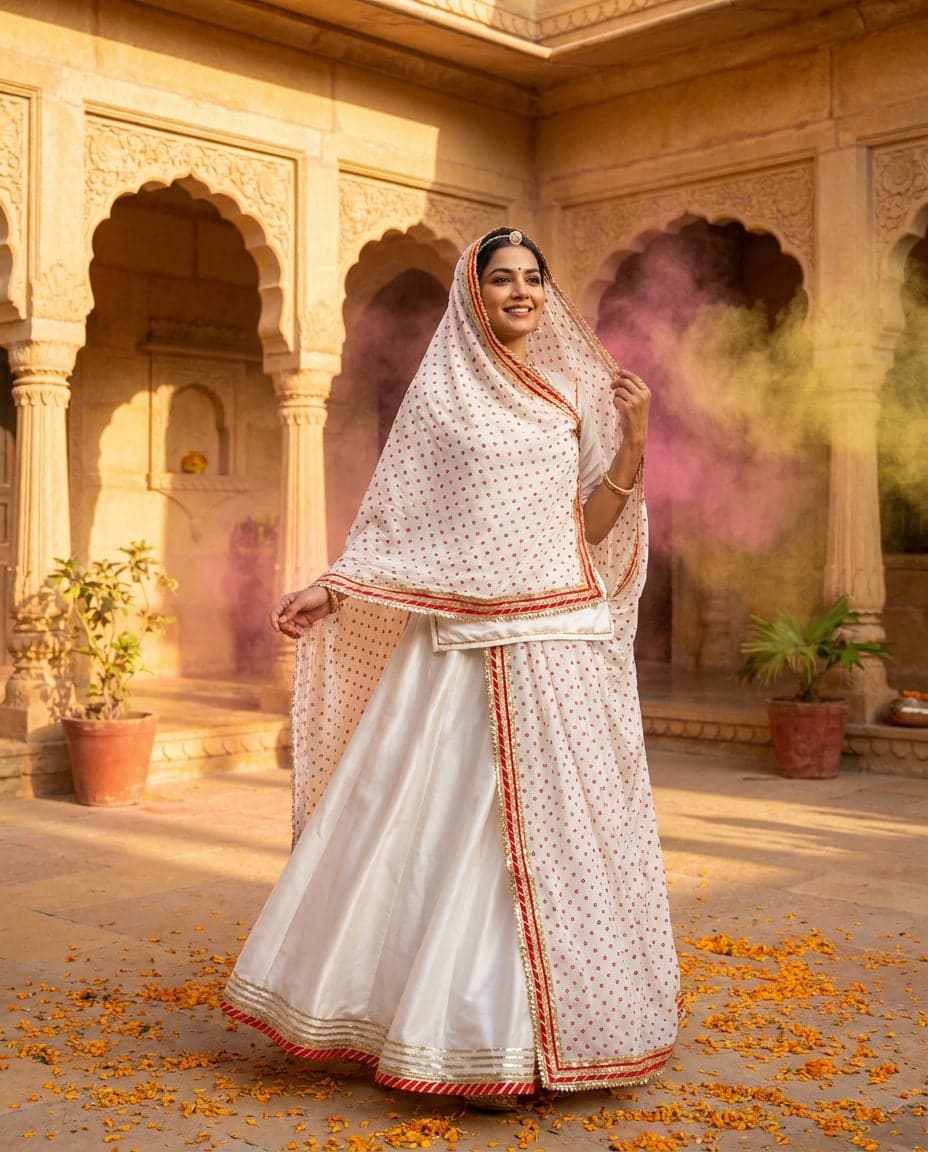
Rajputi poshak vs 'rajasthani dress' — the difference
Every Rajputi poshak is a Rajasthani dress; the reverse is not true. Rajasthani dress is the umbrella — it covers the farmer's ghaghra and the thakurani's poshak alike. Rajputi poshak names something narrower: the formal four-piece set as worn in Rajput households, with its particular cut — a longer kurti, a fuller ghaghra, the odhna draped over the head rather than the shoulder — and its particular occasions.
The work is where the difference shows most. A Rajputi poshak meant for a wedding carries dabka, aari-tari or zardozi laid by hand, sometimes in real silver. That is also where the price difference comes from, which we've covered honestly in our poshak price guide.
And a question we're asked every week: you do not have to be Rajput to wear one. The poshak is Rajasthan's formal dress; it belongs to whoever wears it with affection.
The thakurani dress, and what the name really means
Thakurani is not a garment. It is a title: the wife of a thakur, the lady of a Rajput thikana. When people search for a "thakurani dress" they mean the way those women dressed, and that look is very specific.
It is a Rajputi poshak worn the old way. The kurti runs long, well past the waist. The ghaghra is full, cut in many kali so it moves a half-second after she does. The odhna goes over the head and is held at the temple, never left to slide onto the shoulder. The colours are deep and deliberate: lal, rama, a dusky gulabi, sometimes a black ground lit up with gold. And the jewellery does half the talking, the borla on the forehead, the aad at the throat, the bajuband on the upper arm.
What makes it thakurani rather than simply festive is restraint. The work is dense, but it is placed. Gota along the odhna border, a jaal across the ghaghra, a heavier patch at the kanchli. Nothing scattered for effect. If you want the look, start with a Rajputi poshak in a single strong colour and let the jewellery finish it.
Rajasthani dress for women, region by region
Rajasthan is the size of a country, and its women never dressed as one. The four-piece grammar holds everywhere; the cloth, the dye and the work change with the land. A rough map, from people who buy cloth across all of it:
| Region | Cities | What you'll see | The cloth to know |
|---|---|---|---|
| Dhundhar | Jaipur, Dausa | Lehriya odhnas, gota-heavy festive poshak, block-printed everyday cotton | Lehriya, Sanganeri and Bagru prints, gota-patti |
| Marwar | Jodhpur, Nagaur, Pali | Bright bandhej, heavy wedding poshak, strong reds and pinks | Bandhej, dabka and zardozi work |
| Mewar | Udaipur, Chittorgarh | Softer palettes, fine hand-worked odhnas, dabu-printed daywear | Dabu (mud-resist) print from Akola |
| Hadoti | Kota, Bundi | Featherweight summer saris and odhnas | Kota doria |
| Thar desert | Barmer, Jaisalmer | Dark ghaghras, mirror and thread embroidery, bold appliqué | Ajrakh print, pattu weave |
| Shekhawati | Sikar, Jhunjhunu, Churu | Bandhej and lehriya worn for festivals, practical cotton day to day | Bandhej, printed cotton |
The Rajasthani kurti, and what women actually wear now
Walk through Jaipur on a weekday and you'll see more kurtis than poshaks. That is not a loss. The Rajasthani kurti is the poshak's younger cousin: a straight or flared kurta in bandhej, lehriya or block print, worn with a churidar or palazzo and, quite often, a proper lehriya dupatta on top. College girls wear it. So do their mothers, on the way to the office.
Three combinations hold up well. A bandhej kurta with a plain dupatta, when the print is loud enough on its own. A plain silk kurta with a lehriya odhni, the Teej look for women who won't wear a ghaghra to work. And a block-printed cotton set for summer, which is what Jaipur itself lives in from April to June.
When the occasion is a wedding, though, the kurti steps aside. A festive function is where the four-piece poshak comes out, and nothing else carries the room quite the same way. We keep a few suit sets for the in-between days; the poshak is still what we're known for.
A Rajasthani costume for a function, school day or photoshoot
Not everyone needs an heirloom. Sometimes it's a school annual day, a Rajasthan-themed sangeet, or a pre-wedding shoot against a haveli wall, and you want the look to be right without buying a bridal poshak.
The essentials are fewer than you'd think. A full ghaghra with some swing to it. A kanchli-kurti or a fitted blouse. An odhna long enough to go over the head. Then three pieces of jewellery: a borla (or maang tikka if that's what you have), something heavy at the neck, and bangles up the arm. Colour matters more than price. Lal, pila or a bright lehriya reads as Rajasthani from across a hall; pastels don't.
For children and one-off events, renting or borrowing is perfectly sensible. For a photoshoot, where the camera sits a foot from the cloth, real handwork shows, and that's when a proper poshak earns its keep. Our photoshoot poses guide covers how to stand, sit and turn so the ghaghra photographs the way it should.
Colours, and what they say
Colour in Rajasthan is a language before it is a preference. Lal is suhaag — the bride's colour, the festival colour, the default for anything that matters; our lal collection is the largest for a reason. Pila and kesariya belong to religious days and to the piliya, the yellow odhna that quietly announces a new baby in the family. Rama (a deep sea-green) and firozi (turquoise) are the connoisseur's festive choices — you'll see them at engagements and sangeets. White, worn plain, is kept for mourning, which is why a white poshak is always broken with colour — gota, red magji, a coloured odhna.
Choose by occasion first, complexion second, Instagram last. The old logic still works.
Pieces from our racks
Designer Baby Pink Rajputi Poshak
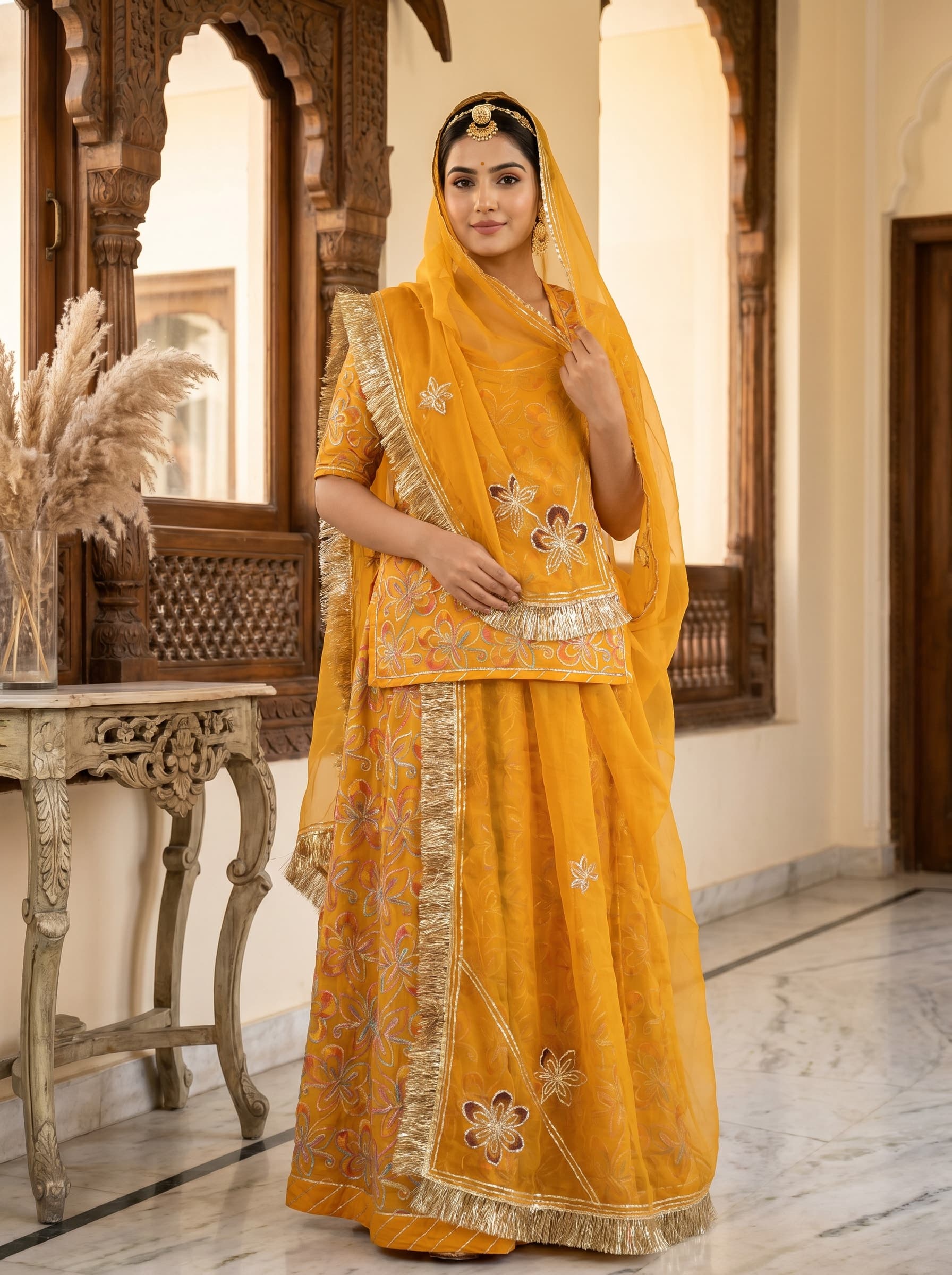
Marigold Yellow Floral Suit
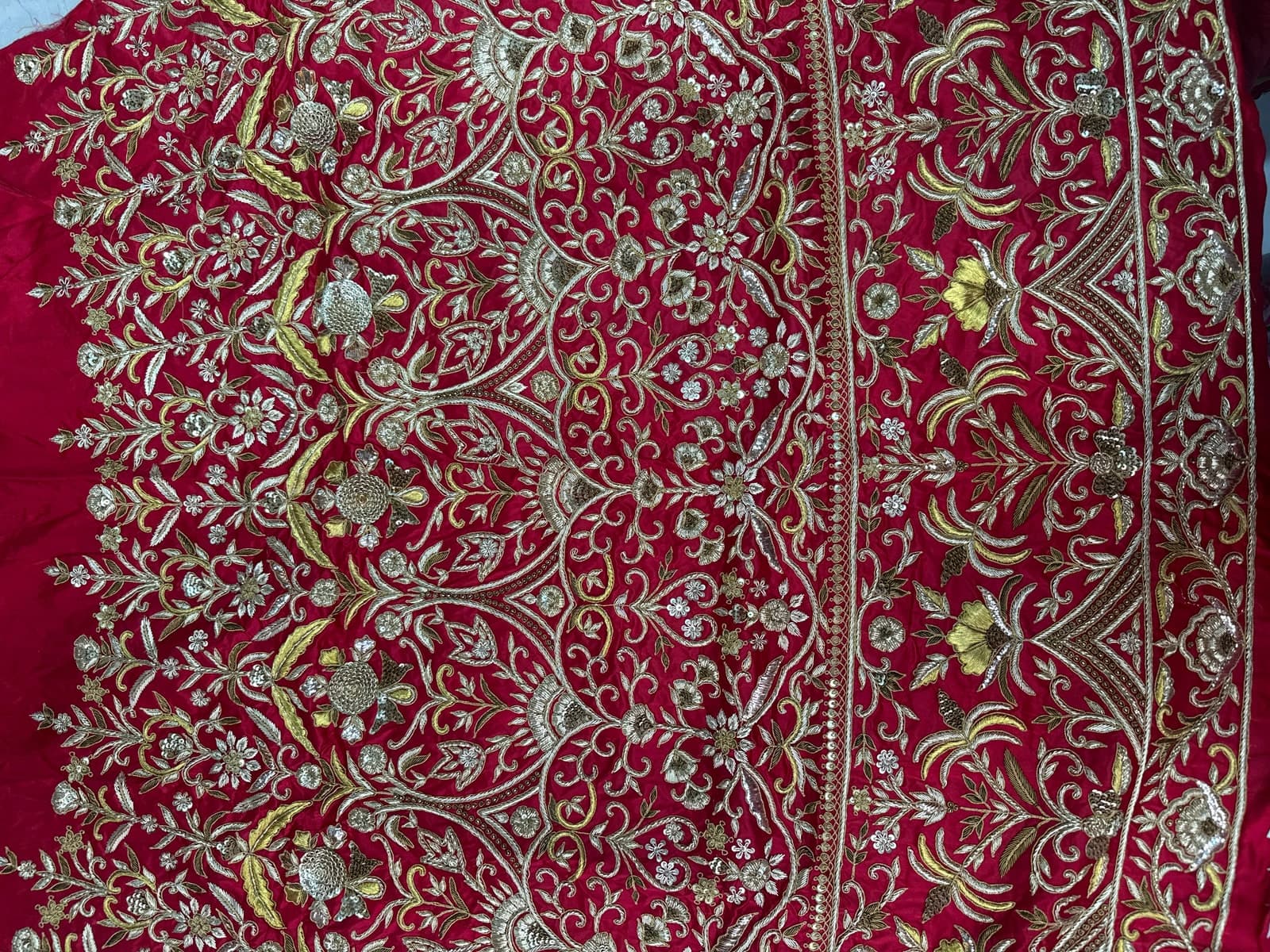
Crimson Bari Rajputi Poshak — Antique Golden Zari
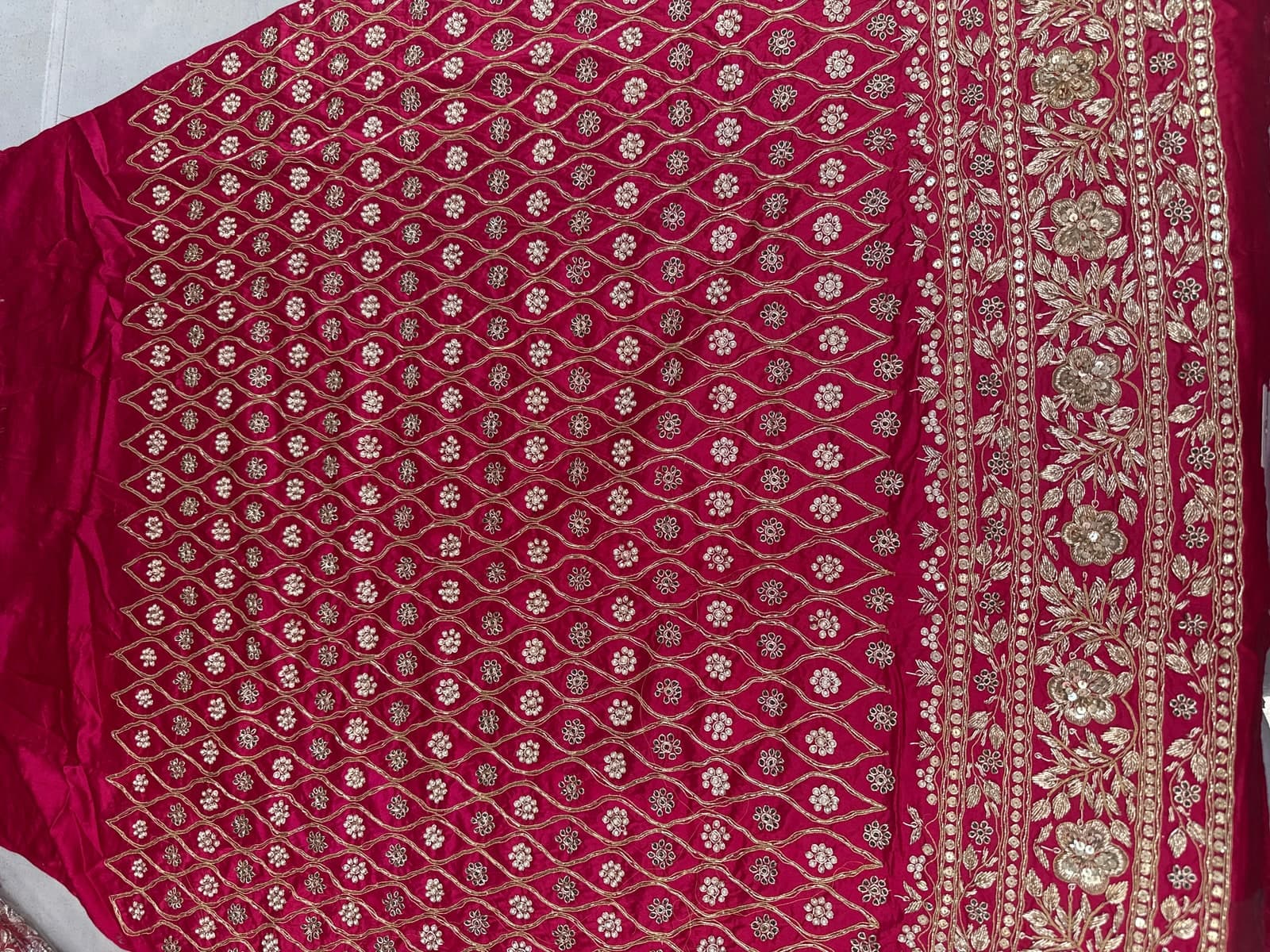
Rani Pink Bari Rajputi Poshak — Gota Jaal
Where to buy, and what to pay
Jaipur remains the honest centre of the trade — Johari Bazaar and Chandpole for browsing, dedicated ateliers for made-to-order work. Jodhpur and Udaipur have their own strong houses. Online, buy from makers who show their handwork up close and state their prices plainly.
As a working range: an everyday ghaghra-kanchli starts around ₹3,000–8,000; a festive hand-worked poshak sits between ₹15,000 and ₹50,000; bridal bari poshaks run ₹20,000 to well past ₹1,00,000 depending on the density of work and the metal in the thread. If a "hand-embroidered" poshak is priced like a bedsheet, it was embroidered by a machine — our price guide shows how to tell.
Every piece we make is numbered, signed, and built to order in about 38 days by our karigars in Jaipur. That is the pace real handwork moves at, and we've stopped apologising for it.
Frequently asked
Last reviewed: 17 May 2026 · Verified by the DivineTatva expert panel
What is the traditional dress of Rajasthan for women called?
The traditional dress of Rajasthani women is the poshak — a four-piece set of kanchli (fitted bodice), kurti, ghaghra (panelled skirt) and odhna (veil). In Rajput households the formal version is called a Rajputi poshak; everyday versions are often just called ghaghra-kanchli.
What do Rajasthani women wear daily?
Day to day, most Rajasthani women wear a light ghaghra-kanchli or a cotton poshak with minimal embroidery, with the odhna draped for sun and modesty. The heavily worked satin and silk poshaks seen in photographs are occasion wear — weddings, Teej, Gangaur and festivals.
What is the difference between a Rajputi poshak and a ghagra choli?
A ghagra choli is two or three pieces — skirt, blouse, dupatta — common across North India. A Rajputi poshak is specifically four matched pieces (kanchli, kurti, ghaghra, odhna) cut as one set, with a longer kurti and the odhna worn over the head. The poshak's kanchli-plus-kurti layering is the giveaway.
Which colour of Rajasthani dress is worn for weddings?
Red (lal). A Rajasthani bride wears a lal bari poshak for the phere, and wedding guests also lean heavily on reds and pinks. Yellow belongs to haldi and religious days, lehriya to the monsoon and Teej, and plain white is avoided at celebrations as it is associated with mourning.
Can a non-Rajput woman wear a Rajputi poshak?
Yes. The Rajputi poshak is Rajasthan's formal traditional dress, and it is worn — and loved — well beyond Rajput families. Wearing one to a wedding, a festival or a photoshoot is taken as a compliment to the culture, not an appropriation of it.
What is a Rajasthani lehriya dress?
Lehriya is Rajasthan's wave-pattern tie-dye, made by rolling and resist-dyeing fine cloth so diagonal waves appear. It belongs to the monsoon: a lehriya odhna or saree is the traditional wear for Sawan and the Teej festival, most often in bright combinations like pink-yellow or five-colour pachranga.
What is a thakurani dress?
A thakurani dress is the Rajputi poshak worn the traditional way, as the wives of Rajput thakurs did: a long kurti over a kanchli, a full many-kali ghaghra, and an odhna held over the head. Deep colours like lal and rama, placed gota or zari work, and Rajputi jewellery such as the borla and aad complete it.
Is a Rajasthani kurti a traditional dress?
The kurti is the everyday, modern form of Rajasthani dress, usually in bandhej, lehriya or block print with a churidar and dupatta. It's traditional in its cloth and dyes, but for weddings and big festivals the four-piece poshak is still the correct choice.
What should I wear as a Rajasthani costume for a school function?
A bright ghaghra, a fitted blouse or kanchli, and an odhna draped over the head, with a maang tikka or borla, a necklace and bangles. Choose lal, pila or a lehriya print so the look reads as Rajasthani from a distance. Renting is fine for a single event.
How much does a Rajasthani dress for women cost?
An everyday ghaghra-kanchli starts around ₹3,000–8,000. A festive hand-worked poshak usually costs ₹15,000–50,000, and a bridal bari poshak runs from about ₹20,000 to well over ₹1,00,000 depending on the density of handwork and whether the thread is real silver.
Written at the atelier in Jaipur, between fittings. If a term here puzzles you — or a shopkeeper uses one we haven't covered — message us on Instagram @thegrandabhaneri and we'll explain it straight.